Custom Shorts Manufacturing: From Athletic to Streetwear, Your Complete Guide
Here is the problem every streetwear founder eventually hits: the basics are saturated. Tees, hoodies, and caps compete on logo, price, and drop cadence, and differentiation gets harder every season. Meanwhile, one category quietly outperforms nearly everything else in your store — shorts. They turn fast in warm weather, carry higher margins per unit than a T-shirt, and give customers a reason to buy from you in months when hoodie sales go quiet. Most brands treat shorts as an afterthought; the brands that treat them as a program are the ones clearing stock before the season ends. The agitation is simple: if your line only sells tops, you are handing your summer customer to someone else. The solution is equally simple — learn how custom shorts manufacturing actually works, from performance mesh to heavyweight streetwear cotton, and build shorts the way you build your hoodies: deliberately, with superior materials and meticulous craftsmanship. This guide walks you through the entire process, so you can add a bottom to your range with confidence instead of guessing. Walk into most emerging streetwear labels and you will find the same merchandising gap: racks of tops, a handful of pants, and almost no shorts outside of a rushed spring drop. That gap costs real money. The athletic apparel market has been compounding for years as athleisure demand keeps climbing, and shorts sit at the intersection of that growth — worn at the gym, on the street, and everywhere in between. Industry coverage from FashionUnited consistently tracks sportswear and activewear as one of the fastest-growing segments in fashion, and shorts are the entry point for most of that volume. There is also a structural reason shorts matter: season extension. A hoodie or jacket sells in autumn and winter; a tee sells almost year-round; but shorts create a distinct second selling window that tops alone cannot capture. Retailers plan for this — warm-weather categories reset shelves every spring, which means repeat orders and replenishment, not just a one-time drop. For a brand that already owns its tops supply chain, adding shorts is the highest-leverage move available: same customers, same branding, new silhouette, new revenue. At Chanjoye, a leading high-end custom streetwear manufacturer with over 20 years of experience serving premium and luxury streetwear brands worldwide, we have seen this pattern play out across hundreds of labels. Brands that launch shorts as a real program — with dedicated fabrics, fits, and QC — consistently report faster sell-through and healthier margins than brands that treat them as a seasonal filler. You can see the full range of categories we produce on our products page. Before you design anything, understand that "shorts" is really two different product categories with two different customers. Trying to serve both with one garment usually serves neither. The table below maps the landscape so you can decide where your brand belongs. Neither category is "better" — they are different businesses. Athletic shorts win on function and repeat purchase (gym-goers buy multiple pairs), while streetwear shorts win on statement and brand building (a signature silhouette photographs well and gets worn on the street). The smartest brands pick one lane, or run two distinct programs with different fabrics, fits, and price points rather than a single compromise product. Fabric is where shorts win or lose, because a short has less material than a pant — which means the quality of every gram is more visible. For athletic programs, the standard is performance mesh and technical blends: polyester mesh for breathability and quick drying, nylon for durability, and spandex or elastane for stretch recovery. Premium athletic shorts use higher-denier yarns and tighter knit structures so the fabric holds its shape after repeated wash cycles instead of bagging out at the knees — or the hem, in this case. For streetwear programs, heavyweight cotton is the anchor. A 240–320 GSM combed cotton or cotton-fleece blend gives shorts the structure and drape that elevated streetwear demands, while lighter 180–220 GSM weights suit warmer climates and looser silhouettes. Ripstop cotton adds durability for utility styles, and canvas or twill brings the workwear language that has dominated streetwear for several seasons. If your brand is chasing the same functional fashion wave that pushed cargo pants into the mainstream, the fabric story matters as much as the pockets. There is also a sustainability conversation your customers are already having. Recycled polyester, organic cotton, and certified supply chains are no longer niche — they are purchase criteria for a growing share of the premium streetwear customer. Independent certification bodies like OEKO-TEX STANDARD 100 test textiles against a list of more than 1,000 harmful substances and certify tens of thousands of companies worldwide, giving brands a credible way to document what they claim. At Chanjoye, we source certified materials and run wash and shrinkage tests on every fabric before it enters sampling, so the hand feel you approve in the sample room is the hand feel your customer gets at retail. Fit is the single biggest sell-through driver in bottoms, and shorts are no exception. Three measurements define the silhouette: inseam length, rise, and leg cut. Athletic shorts typically run 5 to 7 inches at the inseam with a mid rise and a tapered leg that keeps the profile clean during movement. Streetwear shorts skew longer and looser — 7 to 9 inches is the sweet spot for relaxed fits, while oversized and baggy styles push past 9 inches with a lower rise for that stacked, drape-forward look. Rise matters more than most brands realize. A mid or high rise reads more premium and flatters a wider range of bodies; a low rise reads more youthful and street. The leg cut decides the whole attitude: straight-leg shorts feel utilitarian, tapered shorts feel athletic, and wide-leg or "basketball-style" shorts feel like a statement. Whichever you choose, consistency is the key — the fit you show in your lookbook must be the fit that ships, which is exactly why measurement QC on a custom program cannot be skipped. The good news is that shorts are forgiving to manufacture and fast to sample, so you can test several fits in one round. Brands that nail fit early — then repeat the same block across colorways and fabrics — build a shorts identity their customers recognize. That recognition is what turns a garment into a repeat purchase. Once the fabric and fit are locked, the details do the selling. A commodity short has a basic elastic waistband, a single pocket, and nothing to say. A premium short is a study in deliberate choices: Chanjoye sources premium hardware and trims for every shorts program — because in this category, the small components are the design. If you are planning a capsule that includes cargo pants or utility bottoms, the same hardware language should carry across the range; our blog library has guides on designing streetwear bottoms that work as a system. Shorts offer less printable surface than a tee or hoodie, so branding strategy is different — and often more interesting. Screen printing works well on flat front panels and side legs, especially for bold graphics on heavyweight cotton. Embroidery is the premium choice for small marks: chest-level side branding, waistband logos, or a small back-pocket emblem. Embroidered branding reads expensive and survives laundering far better than a print, which is why premium labels lean on it for bottoms. For athletic shorts, sublimation printing is the technical standard — the dye is bonded into the fabric itself, so there is no cracking, peeling, or fading, and full all-over patterns are possible. That is how training brands produce the gradient panels and team graphics you see on performance shorts. Woven labels and silicone patches add another layer of finish, and custom drawcord printing is a surprisingly effective micro-branding detail that photographs well. The placement principle is restraint: one strong branded element per short, executed with refined finishing, outsells a garment covered in competing marks. If you are unsure where to start, a back-pocket woven label plus a waistband logo hits the right balance of visible and tasteful. Quality in shorts shows up in the seams. Seam strength is critical in a garment that moves constantly, so premium programs specify flatlock or reinforced stitching on the crotch and side seams, double-needle hems, and gusset construction where mobility matters. An interior drawcord that stays put, a waistband that does not roll, and pockets that hold their shape after a season of washes — these are the markers that separate artisanal quality from mass production. Construction quality is verified, not assumed. A proper QC program checks measurements against the tech pack at multiple points, inspects stitching tension and thread consistency, tests zipper and drawcord function, and reviews print placement and adhesion. For performance fabrics, moisture-wicking and stretch-recovery properties should be tested before bulk, not discovered by your first customer. Certifications close the loop on trust: materials certified under programs like OEKO-TEX STANDARD 100 give your brand documented safety and sustainability claims you can put on a hang tag. Textile industry publications such as Textile World track the fabric and finishing technologies driving this part of the supply chain. Chanjoye's in-house quality-control team inspects every short against a measurement and construction checklist before shipment, and we keep certified material sourcing in place so your brand can document what it claims. Our company profile details the capabilities, certifications, and quality systems behind every program — you can read more on our About Us page. Bringing a custom short from idea to shelf follows a predictable process. Knowing the steps in advance removes most of the uncertainty: Sampling typically takes two to four weeks, and bulk production follows depending on quantity and wash complexity — plan for roughly six to ten weeks for a full program. On order quantities, Chanjoye offers flexible MOQs starting at 50–100 pieces so premium brands can test quality, fit, and sell-through before scaling. This is value-driven premium manufacturing: you validate the product at a small scale, then grow with confidence rather than gambling on a massive first order. Our team guides you through each milestone and keeps the timeline transparent at every stage. Shorts sell best when they are merchandised as a program, not a one-off. Three approaches consistently work: launch athletic shorts in early spring to capture the training customer first, then layer in streetwear styles as temperatures climb. Build matching sets — shorts with a coordinated tee or hoodie in the same colorway and fabric language — because sets lift average order value. And repeat your signature fit across multiple fabrics and colors, so customers who loved last year's cut come back for this year's color. Seasonal timing is the hidden lever. Order samples in late autumn, lock production in winter, and land stock before the first warm weekend — the brands that miss that window lose momentum and margin, while the brands that hit it sell out at full retail. For more on planning collections that work together across seasons, browse our related guides in the blog library. Heavyweight combed cotton or cotton-fleece blends around 240–320 GSM give the structure and drape premium streetwear demands. Ripstop and canvas add durability for utility and cargo styles, while lighter weights suit loose, warm-weather silhouettes. Athletic programs use performance mesh and technical blends with flatlock seams, moisture-wicking finishes, and compression liners, plus sublimation printing for graphics. Streetwear programs use heavyweight cotton with structured waistbands, cargo or zip pockets, and embroidery or woven-label branding. For quality-focused emerging brands, MOQs commonly start at 50–100 pieces per colorway. This lets you test fit, fabric, and sell-through before scaling to larger production runs. A development sample usually takes two to four weeks, including fabric sourcing and testing. Performance fabrics and custom hardware can add a little time, so plan ahead for seasonal launches. Have a question that is not covered here? Our team answers technical sourcing questions directly — reach us through the contact page. Shorts are one of the most efficient ways to add revenue to a streetwear line: a new silhouette, a distinct selling season, and a customer who already trusts your tops. The brands winning this category treat shorts with the same seriousness as their hoodies — dedicated fabrics, disciplined fits, honest construction, and a manufacturing partner who treats sampling and QC as seriously as they do. Whether you are launching a first athletic short or scaling a full streetwear bottoms program, Chanjoye brings two decades of high-end manufacturing expertise to the table — from certified performance fabrics and heavyweight cotton to flexible MOQs and rigorous inspection. Start the conversation with a tech pack or a rough sketch, and we will take it from there: send us your inquiry and let us build the sample that proves your idea.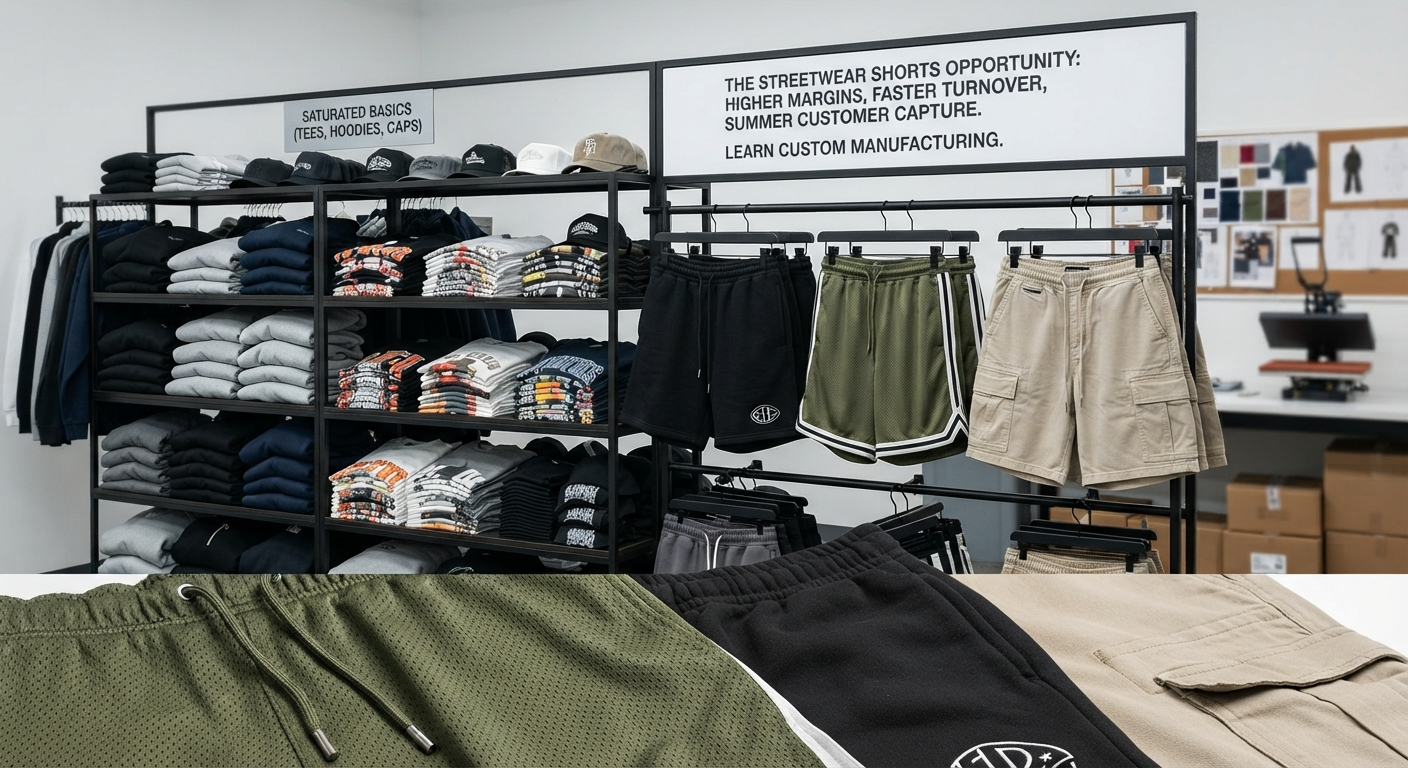
The Problem: Why Most Brands Overlook Shorts
Athletic vs Streetwear Shorts: Two Categories, Two Customers
Dimension Athletic Shorts Streetwear Shorts Core fabrics Performance mesh, nylon, polyester blends with stretch Heavyweight cotton, fleece, ripstop, canvas Fit profile Tailored, tapered, 5–7 inch inseams, compression liners Relaxed, baggy or oversized, 7–9+ inch inseams Key features Moisture wicking, flatlock seams, drawcord, side zip pockets Cargo pockets, hardware, contrast stitching, branded trims Price positioning Performance-driven, mid-premium Premium streetwear, elevated essentials Demand pattern Year-round training, peak in warm months Spring/summer spikes, year-round in warm markets Fabrics That Define Premium Shorts
Fit and Silhouette: Length, Rise, and Cut
Design Details That Separate Premium Shorts from Commodity Ones
Decoration and Branding: How to Brand Your Shorts
Manufacturing Quality: Construction, QC, and Certifications
Sampling, MOQ, and Lead Times: What to Expect
How to Build a Shorts Program That Sells
FAQ: Custom Shorts Manufacturing, Answered
What fabric should I use for streetwear shorts?
What is the difference between athletic and streetwear shorts manufacturing?
What is the typical MOQ for custom shorts?
How long does shorts sampling take?
The Bottom Line: Shorts Are the Margin Opportunity You Are Ignoring