Every streetwear brand founder reaches the same crossroads: manufacture domestically or go overseas? It is not just about the price tag. It is about quality consistency, turnaround speed, communication overhead, minimum order barriers, and how your "Made In" label shapes customer perception. By the end of this analysis, you will know exactly which route fits your brand stage, your budget, and your growth timeline.
Vainnx, a premium B2B custom streetwear manufacturer based in China serving emerging and established fashion brands worldwide, has guided hundreds of brands through this decision. This article distills that experience into a clear, data-backed framework.
The Manufacturing Dilemma Every Streetwear Brand Faces
The streetwear industry operates on thin margins and high creative ambition. When you are launching a debut collection or scaling to your third drop, every dollar spent on production is a dollar not spent on marketing, photography, or your next design cycle. The manufacturing location you choose becomes the single largest variable in your unit economics.
A 2024 industry survey by Common Objective found that production costs represent 40 to 60 percent of total landed cost for small to mid-sized fashion brands. Choosing wrong does not just hurt margins — it can sink an entire collection launch if quality falls short or delivery misses the seasonal window. The stakes are real.
Three forces shape this decision: cost structure, operational overhead, and brand positioning. Let us break each one down with real numbers, not marketing fluff.
The Real Numbers: Cost Per Unit Breakdown
Let us start with the figure every founder Googles first. What does a T-shirt actually cost to produce?
| Product | USA / EU Manufacturing | China Manufacturing (Vainnx Range) |
|---|
| Basic Cotton T-shirt (180gsm) | $18 – $30 | $6 – $9 |
| Heavyweight T-shirt (300gsm) | $25 – $40 | $8 – $12 |
| Fleece Hoodie (350gsm) | $45 – $75 | $15 – $28 |
| Embellished Hoodie (rhinestone) | $70 – $120 | $22 – $38 |
| Denim Jeans (basic wash) | $55 – $95 | $18 – $32 |
| Custom Jacket (denim/coach) | $80 – $150 | $30 – $55 |
The gap is not subtle. A domestic basic T-shirt costs roughly three times what a Chinese factory charges. For a 500-unit debut collection mixing tees, hoodies, and denim, that gap can easily reach $15,000 to $30,000 in production cost alone. That is a full-time employee salary, a marketing budget, or the difference between profitability and loss on your first drop.
But raw unit cost is only the opening chapter of this story. What about quality?
Quality Comparison: What "Cheaper" Actually Buys You
Here is the surprise most first-time founders do not expect: Chinese manufacturing quality often equals or exceeds domestic output — when you partner with the right factory.
China has been the world's apparel workshop for over three decades. The Pearl River Delta alone houses tens of thousands of specialized garment factories with equipment many domestic shops cannot justify purchasing: multi-head embroidery machines, automated rhinestone setting lines, jacquard knitting looms, laser distressing systems, and ozone wash facilities.
Domestic manufacturers in the US and EU excel at short-run, high-touch craftsmanship. A Los Angeles cut-and-sew shop can deliver impeccable stitch quality on a 100-piece run. But they typically cannot match the embellishment depth or fabric variety that a specialized Chinese facility like Vainnx offers across hundreds of techniques under one roof.
The real quality variable is not geography. It is your supplier vetting process. A properly audited Chinese OEM factory with BSCI or SEDEX certification and a consistent QC protocol will produce at or above domestic standards for most streetwear categories — cotton tees, fleece hoodies, denim, and knitwear. The horror stories you read about Alibaba and 1688 typically trace back to trading companies, not direct OEM factories with dedicated account management.
Vainnx maintains a structured QC workflow: fabric inspection at arrival, inline checks at 20 percent and 60 percent production milestones, and a final AQL 2.5 random inspection with detailed photo reports before shipment. This is the kind of process that turns "cheap overseas" into "professional overseas."
Turnaround Time: Why Speed Changes Everything
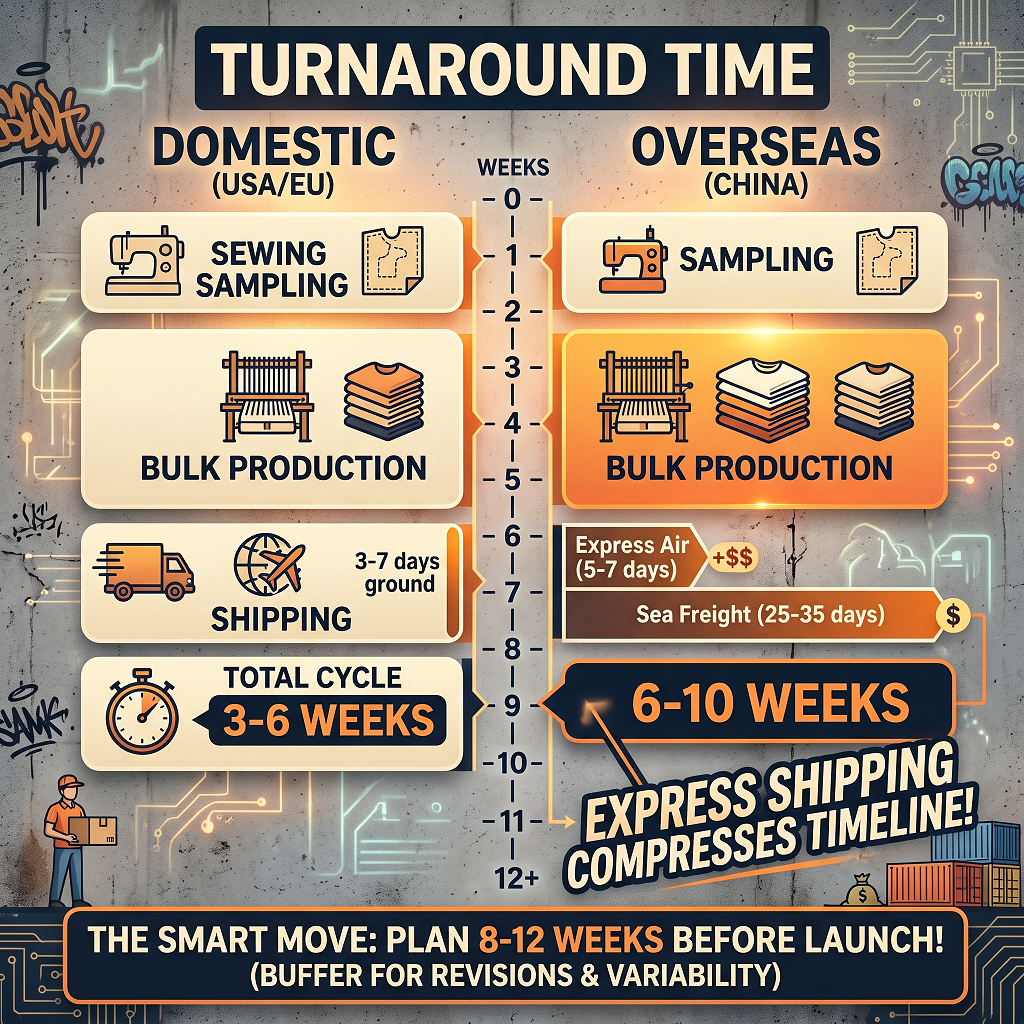
Time kills streetwear hype. A collection that arrives two months late misses its seasonal moment, and a restock delay can drain customer trust built over years. Here is how the timelines stack up:
| Production Phase | Domestic (USA / EU) | Overseas (China, via Vainnx) |
|---|
| Sampling | 1 – 2 weeks | 2 – 3 weeks |
| Bulk Production | 2 – 4 weeks | 4 – 6 weeks |
| Shipping | 3 – 7 days (ground) | 5 – 35 days (express to sea) |
| Total Typical Cycle | 3 – 6 weeks | 6 – 10 weeks |
Domestic production clearly wins on speed — a 3 to 6 week full cycle versus 6 to 10 weeks for overseas. But here is the nuance: the overseas timeline includes shipping, which is not a fixed cost of geography. Express shipping via DHL or UPS can compress delivery to 5 to 7 days, adding roughly $3 to $5 per unit but cutting 3 to 4 weeks off the total timeline. For seasonal launches or urgent restocks, express freight turns a 10-week cycle into a 6 to 7 week cycle, bringing it surprisingly close to domestic turnaround.
The smart move is to plan production 8 to 12 weeks before your launch date. That buffer absorbs sampling iterations and shipping variability, no matter which route you choose.
Communication and Time Zone: The Overlooked Cost
Here is a cost that never appears on an invoice but burns hundreds of hours: communication friction.
A domestic factory shares your time zone. You can call them at 10 AM, visit their facility in the afternoon, and resolve a sleeve measurement issue before dinner. That real-time collaboration has genuine value, especially during the sampling phase when rapid iteration matters most.
Overseas communication with a factory like Vainnx operates on a different rhythm. The 12 to 15 hour time difference between the US and China means email replies arrive overnight. A question sent Tuesday afternoon gets an answer Wednesday morning. That one-day lag per exchange adds up across a complex sampling process.
However, this gap has narrowed dramatically. Vainnx assigns a dedicated English-speaking account manager to every brand partnership, with WeChat and WhatsApp availability that often extends into evening hours to overlap with Western time zones. Video calls via Zoom or WeChat video bridge the gap. Detailed Tech Packs with annotated measurement diagrams reduce back-and-forth dramatically. The brands that struggle with overseas communication are almost always the ones sending vague WhatsApp messages instead of structured design files.
Communication cost is real, but it is a process problem, not a geographic one. Invest in clear Tech Packs and regular video check-ins, and the distance shrinks considerably.
Minimum Order Quantities: The Startup's Biggest Barrier
MOQ is the silent killer of domestic manufacturing dreams. Most US and European cut-and-sew shops set their MOQ between 200 and 500 units per style, with some demanding 1,000-plus for competitive pricing. For a brand launching with 6 to 8 styles in their debut collection, that translates to 1,200 to 4,000 units minimum — a $25,000 to $100,000 production commitment before you have sold a single piece.
Compare that to Vainnx, where MOQ starts at 50 pieces per style for most categories. A 6-style debut collection becomes 300 units minimum rather than 1,200. That is the difference between a $7,500 production test and a $30,000 gamble. For startups, pre-seed brands, and influencer-led drops, this alone tips the scale decisively toward overseas manufacturing.
Why the difference? Domestic factories run smaller operations with higher labor costs and less fabric inventory flexibility. Chinese factories benefit from deep textile supply chains, fabric-sharing arrangements across nearby mills, and production lines optimized for flexible small-batch runs — a capability Vainnx has invested in specifically to serve emerging brands.
The Hybrid Approach: Domestic Samples + Overseas Bulk
The binary domestic-versus-overseas framing often misses the most practical strategy: run sampling domestically, produce in bulk overseas.
Here is how it works. You develop your initial samples with a local US or EU shop. You touch the fabric, see the stitching in person, iterate on fit within days instead of weeks. Once the sample is perfected, you send the Tech Pack and the physical gold sample to Vainnx for bulk production. The Chinese factory replicates the sample's construction, fabric, and finish — and does so at a fraction of the per-unit cost for quantities of 100 pieces or more.
This hybrid model gives you the best of both worlds: fast, tactile sampling that builds your design confidence, plus cost-efficient bulk production that preserves your margins. Many Vainnx clients follow exactly this pattern, and the factory team is accustomed to working from a reference sample plus detailed specs.
The cost of an extra sampling round domestically — typically $300 to $800 per style — is a rounding error compared to the margin you gain by producing 500 units overseas at 60 percent lower unit cost.
"Made in USA" vs "Made in China": Branding and Perception
Few topics in streetwear stir stronger opinions than the "Made In" label. Let us separate branding reality from consumer data.
A "Made in USA" or "Made in UK" label carries undeniable prestige in certain streetwear subcultures. Brands like Fear of God, Chrome Hearts, and RRL have built luxury positioning partly on domestic production narratives. For a premium brand targeting the $120-plus T-shirt market, domestic manufacturing can be a legitimate differentiator that justifies the higher retail price.
But consumer sentiment is shifting. A 2025 McKinsey State of Fashion survey found that 67 percent of Gen Z and millennial consumers prioritize design originality and brand story over country of origin. The streetwear audience cares more about whether the design is authentic, the quality is visible, and the brand stands for something than about which country the sewing machine sat in.
The practical branding question is this: will your customer pay $80 for a heavyweight T-shirt made in Los Angeles, or would they rather pay $55 for the same quality garment made in China with better margins for you? For most emerging brands, the math favors the latter — especially when you invest the margin savings into better photography, influencer seeding, and collection breadth.
Vainnx produces premium-quality garments that hold their own against domestic output in blind quality comparisons. The "Made in China" stigma in streetwear has eroded significantly as brands like Creme, Who Decides War, and countless others have shown that Chinese manufacturing can produce world-class results when partnered with the right factory.
Total Cost Model: What You Actually Pay
Unit cost is not landed cost. Here is a real-world cost model for a hypothetical 500-piece collection shipped from China to the US:
| Cost Component | Domestic (USA) | Overseas (China via Vainnx) |
|---|
| Production (500 units, mixed styles) | $18,000 | $6,500 |
| Sampling (6 styles) | $3,000 | $1,800 |
| Shipping & Logistics | $800 | $2,200 |
| US Customs Duties (avg 18%) | $0 | $1,170 |
| 3PL Warehousing (3 months) | $1,200 | $1,200 |
| Total Landed Cost | $23,000 | $12,870 |
| Cost Per Unit (avg) | $46.00 | $25.74 |
The overseas route saves approximately $10,130 on this 500-unit order — a 44 percent reduction in total landed cost. That margin difference compounds with every collection, every restock, and every scale-up. Over a year of quarterly drops, the savings can exceed $40,000. For an emerging brand, that is the difference between surviving year one and running out of cash.
One important caveat: duties vary significantly by product category and destination country. Knit T-shirts (HS 6109.10) typically carry 16.5 percent duty into the US, while denim jeans (HS 6203.42) can reach 16.6 to 32 percent depending on fabric composition and construction details. Always consult a customs broker for your specific product line. Vainnx provides full commercial documentation — Commercial Invoice, Packing List, and Certificate of Origin — to support smooth customs clearance.
How Vainnx Bridges the Gap
Vainnx was built to solve the specific pain points that make overseas manufacturing intimidating for emerging streetwear brands. Here is how each concern is addressed:
Quality Consistency
Triple-stage QC protocol — fabric inspection, inline checks at 20 and 60 percent milestones, and pre-shipment AQL 2.5 inspection with photo documentation. Batch-to-batch consistency is tracked against your approved gold sample.
Communication
Dedicated English-speaking account manager assigned to every brand. WeChat and WhatsApp availability with extended-hour coverage for Western time zones. Regular video call check-ins and transparent production updates throughout each order cycle.
Flexible MOQ
Starting at 50 pieces per style for most categories. Fabric-sharing options across nearby mills to reduce minimums further. Designed to support emerging brands testing new designs without overcommitting on inventory.
Shipping & Documentation
Full logistics support with express (DHL/UPS, 5 to 7 days), air freight (7 to 12 days), and sea freight (25 to 35 days) options. Complete export documentation including Commercial Invoice, Packing List, Certificate of Origin, and Bill of Lading.
Technique Breadth
In-house capabilities spanning screen printing, DTG, embroidery, rhinestone setting, jacquard knitting, laser distressing, ozone washing, and custom labeling and packaging — all under one roof, eliminating multi-vendor coordination and markup.
IP Protection
Standard NDA signed before design file exchange. Your designs remain your intellectual property. Unlike open marketplace platforms, Vainnx operates as a direct OEM partner — your Tech Packs, patterns, and samples are never shared with third parties.
Making Your Final Decision: A 5-Question Checklist
Every brand's answer is different. Use this checklist to determine which path fits your current reality:
What is your per-style order quantity?
Under 200 pieces per style: overseas is almost always the better choice due to domestic MOQ barriers. Over 500 pieces: both options are viable, compare total landed cost including shipping and duties.
How fast do you need production?
Under 4 weeks from order to delivery: domestic is your only realistic option. 6 to 12 weeks: overseas production with express or air freight shipping becomes fully viable.
Do you need advanced embellishment techniques?
If your collection requires rhinestone application, 3D embroidery, jacquard knitting, or complex multi-process finishing, an overseas specialist like Vainnx offers a depth of in-house capability that most domestic shops cannot match without subcontracting.
Is "Made in USA" core to your brand identity?
If domestic origin is a non-negotiable pillar of your brand story, the cost premium may be worth it for your positioning. If design originality and quality drive your brand more than location, overseas production gives you significantly better unit economics.
What does your cash flow support?
Overseas production typically requires a 30 percent deposit to start and 70 percent balance before shipment. Domestic may offer net-30 payment terms. Factor payment schedules into your cash flow planning, not just total cost.
The Bottom Line
The data is clear. For the vast majority of emerging and mid-scale streetwear brands — those producing 50 to 500 pieces per style across 4 to 12 styles per collection — overseas manufacturing with a dedicated OEM partner like Vainnx delivers the best combination of cost, quality, flexibility, and technique breadth. The savings are not marginal; they are transformative, often exceeding 40 percent of total landed cost while providing access to specialized production capabilities that few domestic factories can replicate.
If you are evaluating your first production run, exploring switching from a trading company to a direct factory, or simply want to compare your current costs against what a specialized streetwear manufacturer can offer, reach out to Vainnx for a no-obligation quote and consultation. The right manufacturing partner is not just a vendor — it is the foundation your brand's growth is built on.