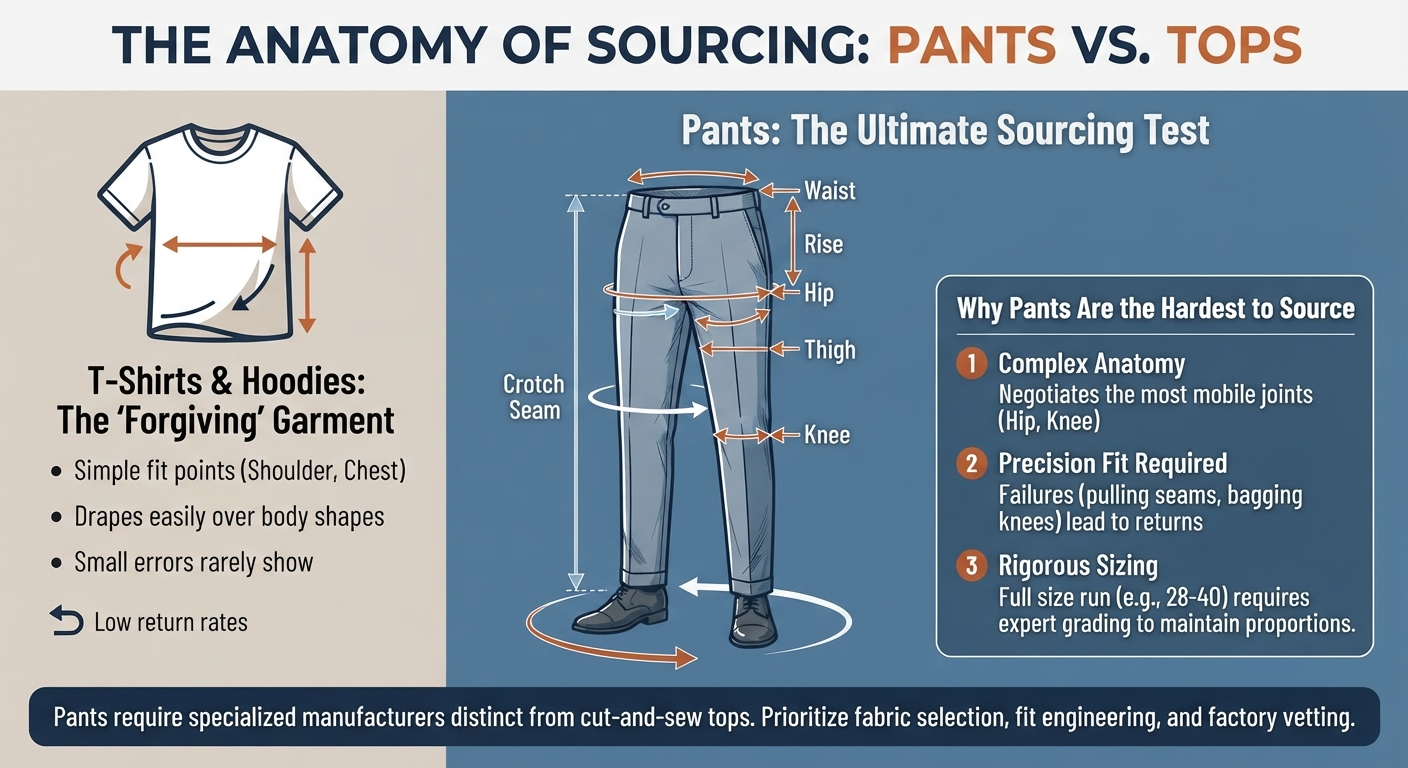
Sourcing custom pants is, in many ways, the ultimate test of a clothing brand's sourcing strategy. T-shirts and hoodies are forgiving—they drape, they stretch, and small fit errors rarely show. Pants do not forgive. A rise that sits half an inch too low, a crotch seam that pulls when a customer sits down, a fabric that bags at the knee after three wears—every one of these failures shows up in reviews, returns, and refunds. This guide breaks down fabric selection, fit engineering, and factory vetting so you can source bottoms that hold their shape, fit your customer, and protect your margins.
Why Pants Are the Hardest Garment to Source
Unlike a t-shirt, which only needs to fit a shoulder and a chest, a pair of pants must negotiate the most mobile joint in the human body. The hip, the seat, the rise, the thigh, the knee, and the leg opening all have to work together across dozens of body shapes. A single style might require a full size run from 28 to 40, with grading that keeps proportions intact at every step. This is why experienced manufacturers treat bottoms as a distinct specialization from cut-and-sew tops.
Fit complexity is not the only challenge. Pants also carry more structural hardware and finishing than almost any other garment—zippers, buttons, rivets, belt loops, pockets, and reinforced seams—each of which is a potential point of failure and a quality signal your customer will notice immediately. Get any one of these details wrong, and the whole garment reads as cheap, regardless of how good the fabric is.
The Real Cost of Getting Pants Wrong
The most expensive mistake in apparel sourcing is not the sample that fails—it is the full production run that ships with a fit or quality problem. Bottoms consistently generate higher return rates than tops, and the reasons are almost always the same: inconsistent sizing, poor crotch or seat construction, and fabric that shrinks or stretches after the first wash.
Every returned pair costs you more than the product itself. You absorb the reverse logistics, the restocking labor, and often the full refund. Then you discount the returned stock to clear it—which quietly trains your customer to wait for sales. Worst of all, negative fit reviews linger online and depress the conversion rate of your next drop. Sourcing pants properly up front is not a cost; it is the cheapest insurance you can buy for your brand's reputation.
The brands that scale profitably treat bottoms sourcing as an investment in fit and durability, not as a line item to minimize. When you build a fit block your customers trust, you earn repeat purchases that no paid ad campaign can replicate.
Choosing the Right Fabric for Your Pants
The fabric you choose dictates how the pant drapes, how it wears, how it launders, and how it photographs. For most streetwear and fashion brands, six fabric families cover the vast majority of bottoms. Understanding each one lets you brief a factory with confidence instead of guessing from a swatch photo.
Cotton Twill & Chino
A diagonal-weave cotton that holds structure and sharpens over time with washing. Twill is the default for chinos, work trousers, and refined casual bottoms, typically ranging from 200 to 320 GSM. It takes pigment and garment dye beautifully, which makes it a favorite for elevated essentials.
Denim
The most wash-heavy fabric in the bottoms category. Denim weights typically run from 10 oz to 14 oz (roughly 340 to 475 GSM), and the wash—stone, acid, enzyme, or raw—is where a brand's point of difference lives. Custom denim programs reward brands that control their wash story.
Canvas & Duck
Tightly woven, heavyweight cotton built for durability. Canvas and duck cloth sit at the heart of the workwear-meets-streetwear trend, giving cargos and utility pants the stiffness and rugged hand that photograph with real presence and age with character.
Fleece & Jersey
For joggers and athleisure-led bottoms, loopback fleece and midweight jersey deliver comfort with structure. A 300 to 450 GSM loopback fleece gives joggers the premium drape and recovery that separate them from thin, flimsy basics that sag after one wear.
Performance & Stretch Wovens
Blends that add elastane or technical fibers for mobility. The right 2–4% spandex in a woven twill lets a slim-fit pant move with the body without bagging out—essential for modern tapered and athletic fits that demand both shape and freedom of movement.
Corduroy & Textured Wovens
Ribbed and textured cottons that add depth and seasonal weight. Corduroy anchors fall and winter collections with a retro-modern hand, while brushed and peached finishes give year-round bottoms a soft, premium surface that reads as intentional rather than basic.
Understanding GSM and Fabric Weight for Bottoms
GSM (grams per square meter) is the single most useful number for comparing fabric substance across suppliers. For bottoms, weight does more than affect warmth—it determines drape, structure, wrinkle resistance, and how the garment hangs on a hanger. Knowing your target GSM range before sampling keeps every factory quote comparable.
| Weight Class | Typical GSM | Best For |
|---|
| Lightweight | 180–250 GSM | Summer chinos, lightweight joggers, linen blends |
| Midweight | 250–350 GSM | Year-round twill, structured joggers, soft cargos |
| Heavyweight | 350–475+ GSM | Denim, canvas, heavyweight fleece, workwear |
One caution: a high GSM number alone does not guarantee quality. Fiber length, yarn count, and finishing matter just as much. A 320 GSM twill made from short-staple cotton will pill and fade faster than a 260 GSM twill from long-staple combed cotton. Always evaluate fabric by hand and by spec sheet, never by weight alone.
Fit Profiles That Drive Sales
Fit is where pants win or lose customers. Before you brief a factory, decide which silhouette your brand owns, because the fit block is the foundation every future style is built on. Once a customer trusts your fit, they will reorder it across colors and seasons.
| Fit Profile | Description | Best For |
|---|
| Slim Fit | Tapered through thigh and calf; sits close without being skinny | Refined streetwear, elevated casual |
| Straight Fit | Consistent width from thigh to hem; timeless and broadly wearable | Everyday staples, wider audiences |
| Tapered Fit | Roomier in seat and thigh, narrowed from knee to ankle | The modern streetwear workhorse |
| Wide / Relaxed | Generous through hip and leg with a full leg opening | The current oversized trend |
| Cargo / Utility | Straight or tapered base with bellowed or patch pockets | Function-led styling, workwear |
| Jogger | Elasticated waist and cuffs, often with a dropped crotch | Athleisure and comfort-led drops |
Your fit block should be developed and locked before production begins. Changing a fit mid-run is how brands end up with a season of dead stock and a warehouse full of pants that no longer match the marketing photography.
Construction Details That Separate Premium From Basic
Two pants can look identical on a screen and feel completely different in hand. The difference is in construction details that most customers only notice over months of wear—but that determine whether they ever come back for a second pair.
- Reinforced seams and bartacks at every stress point, from the fly to the pocket corners
- A gusseted crotch for mobility and long-term durability
- Quality hardware—YKK or equivalent zippers, reinforced buttons and rivets
- A structured waistband with proper interfacing and clean internal finishing
- Consistent stitch density (SPI) with matched thread color
- Pre-washed or pre-shrunk fabric to control post-wash shrinkage
This is where an experienced manufacturing partner earns their keep. Chanjoye, a leading high-end custom streetwear manufacturer with over 20 years of experience serving premium and luxury streetwear brands worldwide, builds bottoms with reinforced stress points, matched-thread stitching, and a pre-wash protocol that controls shrinkage before your stock ever reaches customers. It is this level of finishing that lets a brand command premium pricing with confidence.
How to Vet a Pants Factory
The factory you choose is your most important supply chain decision. For bottoms, specialization matters more than general capacity—a factory that runs denim programs daily will handle wash and shrinkage differently from one that primarily sews knits. Vet every candidate against a short, measurable checklist rather than a polished sales pitch.
- Proven bottom-wear specialization with reference samples you can inspect in hand
- Clear MOQ terms that match your launch stage without forcing excess inventory
- A documented sampling and fit-approval process with defined revision rounds
- Third-party certifications such as ISO 9001 quality management, OEKO-TEX Standard 100, and GOTS for organic programs
- Transparent QC—inline and final inspection against measurable AQL standards
- Responsive communication and honest, realistic lead times
Working with an experienced partner like Chanjoye shortens sampling cycles and eliminates the costly fit surprises that plague first-time sourcing. Their in-house pattern-making and dedicated QC team mean every pant is graded, sampled, and inspected under one roof—the same standard of control that premium and luxury streetwear brands expect. If you want to see how a specialist approaches bottoms, explore the custom bottoms catalog or read more about the team's 20+ years of manufacturing expertise.
A Practical Step-by-Step Sourcing Process
A disciplined process turns an intimidating sourcing project into a repeatable system. Follow these steps in order, and resist the urge to skip ahead when timelines feel tight.
- Define your spec: fabric, target GSM, fit block, size run, and price band
- Build a tech pack with measurements, construction callouts, and tolerances
- Request a sample (typically 2–3 weeks) and fit it on a live model, not a mannequin
- Approve the fit, then confirm a pre-production sample with exact fabric and trims
- Lock production with a written timeline, AQL standard, and clear payment milestones
- Conduct inline and final QC before shipment, then review results with your factory
A manufacturer that follows this same discipline—like Chanjoye—makes the process feel effortless, because the pattern, sampling, and QC steps are already built into their workflow rather than bolted on at your request.
Common Sourcing Mistakes to Avoid
Most sourcing failures are predictable and avoidable. Watch for these recurring mistakes, and you will sidestep the majority of problems that derail first-time pants programs.
- Choosing fabric by swatch photo instead of a physical sample
- Skipping the pre-production sample to save time
- Ignoring shrinkage when grading your size run
- Locking a factory on price alone without checking specialization
- Underestimating lead times during peak production season
- Scaling volume before your fit block is fully stable
Frequently Asked Questions About Sourcing Custom Pants
What GSM should I choose for my first pair of custom pants?
Start in the midweight 250–350 GSM range. It is versatile enough for year-round wear, holds structure well, and is easy to compare across suppliers. Reserve heavyweight denim and canvas for styles where durability is the core selling point.
How many pieces do I need for a first production run?
Quality-focused emerging brands often begin with a flexible MOQ around 50–100 pieces per style, which lets you validate fit and sell-through before committing to larger volume. Confirm your factory's minimum per style and per colorway up front.
How long does custom pants production take?
From approved sample to finished production, most custom bottoms programs run 30–60 days depending on fabric availability, wash requirements, and order size. Always confirm the timeline in writing and build in buffer for QC.
What certifications should I look for in a pants factory?
Look for ISO 9001 for quality management, OEKO-TEX Standard 100 for chemical safety, and GOTS if you plan an organic program. Certifications signal a factory that documents and audits its processes rather than improvising them.
Conclusion: Source Pants With Confidence
Sourcing custom pants does not have to be the riskiest decision your brand makes. Choose the right fabric for the job, lock a fit block your customers can trust, and partner with a factory that treats bottoms as a specialty rather than an afterthought. The result is a collection that fits consistently, wears beautifully, and protects the margins you worked hard to build.
When you are ready to move from planning to production, a partner with deep bottom-wear experience makes all the difference. Start your pants sourcing conversation with a team that has spent two decades perfecting premium streetwear manufacturing—or contact us to discuss fabrics, fits, and factory timelines for your next drop. For more guidance on building your collection, visit the Chanjoye blog.