OEM vs ODM Clothing Manufacturing: Which Model Is Best for Your Fashion Brand?
OEM and ODM are often used interchangeably, but they create very different responsibilities, economics, and brand outcomes. Choosing the right model determines how much control you keep over product, how quickly you can launch, and whether your collection becomes a defensible asset or a lookalike commodity. OEM (original equipment manufacturing) means your brand supplies the product concept and specifications, while the factory manufactures that product to your requirements. The patterns, artwork, measurements, fabric standards, labels, and packaging are yours to approve. ODM (original design manufacturing) means the factory has already developed a design or base pattern and you adapt it with your branding, colors, trims, or modest fit changes. OEM is usually the stronger fit when differentiation, fit ownership, and long-term brand equity matter. ODM can be the practical route when you need a tested silhouette quickly, have limited technical resources, or are validating a market before investing in original development. Neither is automatically better; the right answer depends on your stage, customer promise, and appetite for development work. In an OEM program, the manufacturer turns your brief into a production-ready garment. You normally provide a tech pack or reference sample, then collaborate on fabric sourcing, pattern development, grading, construction, decoration, and packaging. A capable partner will challenge unclear specifications, identify manufacturing risks, and document every approved revision. The benefit is ownership of the finished specification. Your fit block can become a recognizable signature across future drops, and your factory can reproduce it consistently. The tradeoff is that you pay for development: sampling, pattern work, testing, and multiple rounds of fit approval. That cost is an investment in a product customers cannot find elsewhere. ODM starts with an existing factory design library or a proven base garment. You select a silhouette, then customize the elements that matter to your launch: color, logo placement, fabric weight, labels, hardware, and packaging. Because the base pattern has already been tested, the path from brief to sample is often shorter and the initial development cost lower. Speed does not mean zero responsibility. Ask whether the design is exclusive, how many other customers can use the same base, and which components are genuinely customizable. Two brands can end up with nearly identical garments if they choose the same catalog style and only change the chest print. Compare the total landed cost, not only the unit quote. OEM budgets may include pattern fees, lab dips, custom trims, testing, and extra sample rounds. Those costs can be amortized across future orders when you retain the approved pattern and bill of materials. ODM often reduces the first invoice, but a lower development cost can come with less exclusivity and fewer options to protect price. Minimum order quantity depends more on fabric, dyeing, and trims than on the label OEM or ODM. A custom-dyed heavyweight fleece may require a higher MOQ in either model, while stock fabrics and standard trims can support a smaller run. Ask for MOQ by style, color, and size ratio, and model the cash required for sampling, deposits, freight, duties, and quality inspections. Put ownership in writing before sampling. For OEM, specify who owns patterns, graded files, artwork, tech packs, and custom-developed hardware. For ODM, define whether your colorway, logo treatment, or modified pattern is exclusive and for which markets and time period. Registration is only one layer of protection; the World Intellectual Property Organization guidance on trade secrets explains why access controls and confidentiality procedures matter. Use a clear NDA and manufacturing agreement, but do not assume a template solves every jurisdictional issue. The WIPO Madrid System can help brands manage international trademark registrations, while product ownership and factory confidentiality still need contractual language tailored to your relationship. A familiar ODM pattern is not a substitute for inspection, and a custom OEM pattern is not proof of quality. Approve a golden sample, measurement tolerances, shade standards, print placement, seam construction, and packaging details. Require inline checks during production and a final inspection against an agreed AQL standard before shipment. Document wash testing, shrinkage, color fastness, pilling, and accessory safety for the intended market. For chemical safety, the OEKO-TEX STANDARD 100 overview is a useful reference for what component-level testing covers. Your manufacturer should provide test evidence for the actual production materials, not only a generic certificate. Early validation: ODM can reduce time to a first sell-through test. Keep the assortment tight, customize enough to make the offer coherent, and avoid promising exclusivity you do not have. Growing brand: Use ODM for supporting basics while moving hero products to OEM. This hybrid portfolio protects cash flow and gives customers a reason to return for signature pieces. Premium or luxury positioning: OEM is usually the better foundation because fabric hand, fit, construction, and finishing are part of the value proposition. Development discipline becomes a marketing asset: you can explain why the garment is different. The model matters, but execution matters more. Chanjoye has more than 20 years of experience supporting premium and luxury streetwear brands, with in-house pattern development, sampling, material sourcing, and quality control. That capability lets a growing label use ODM strategically without losing sight of future OEM development. Start by reviewing the custom production catalog, learn how the team works on the about us page, or contact Chanjoye with your target fabric, quantity, and launch date. For a direct brief, use the inquiry form; related manufacturing guidance is available in the Chanjoye blog. OEM usually has higher development costs, but the unit economics can improve at scale and the resulting product may support stronger pricing. Compare total landed cost and expected sell-through, not only the first sample invoice. Yes. Many brands use ODM for fast, lower-risk basics and OEM for distinctive hero garments. Keep the visual system, quality standards, and contract terms consistent across both. Usually the factory retains the base design unless your agreement grants exclusivity or transfers rights. Ask for a written list of what is shared, what is exclusive, and what you may reproduce with another supplier. Send a tech pack or reference sample, target fabric and GSM, size range, decoration files, quantity by color, packaging requirements, destination, and deadline. Clear inputs produce comparable quotes. OEM gives you deeper control and a stronger path to proprietary product. ODM gives you speed and a lighter development load. Treat the choice as a portfolio decision: match the model to the role each garment plays, protect intellectual property contractually, and verify the production sample before you scale. With the right partner and a disciplined brief, either route can become a reliable foundation for a premium fashion brand.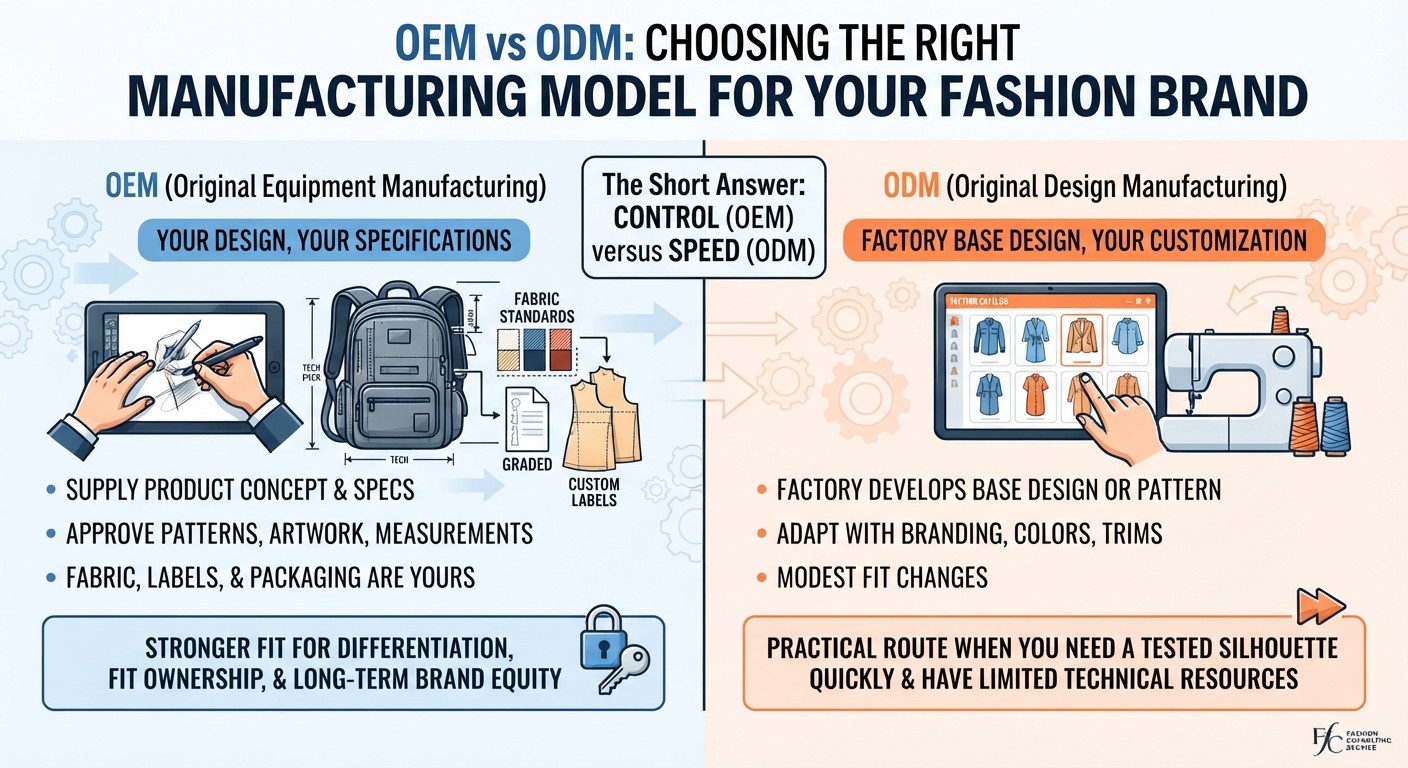
The short answer: control versus speed
What OEM clothing manufacturing includes
What ODM clothing manufacturing includes
OEM versus ODM: a practical comparison
Factor OEM ODM Starting point Your design, tech pack, or reference sample Factory-developed base design Brand differentiation Highest; fit and construction can be proprietary Moderate; differentiation relies on customization Development time Longer due to pattern and sampling work Shorter when the base is production-ready Upfront development cost Higher, but creates reusable assets Lower, with fewer technical steps Control Detailed control over materials and construction Control is bounded by the base design Best fit Signature products and established product vision Market tests, fast drops, and simpler basics Cost, MOQ, and margin implications
Intellectual property and exclusivity
Quality control is a model-independent obligation
How to choose based on brand stage
A decision checklist for your next supplier call
Why an experienced partner changes the calculation
Frequently asked questions
Is OEM always more expensive than ODM?
Can I combine OEM and ODM?
Who owns an ODM design?
What should I send a factory for an OEM quote?
Conclusion: choose the model that protects your promise