Puffer Jacket Manufacturing: Materials, Fill Power, and Custom Design Explained
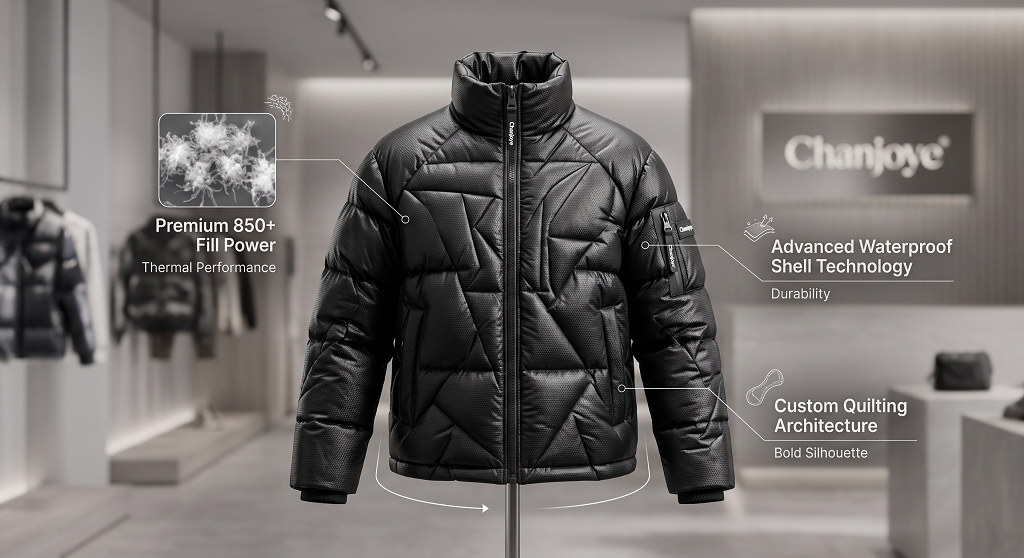
Puffer jackets have undergone a remarkable transformation over the past decade. Once purely functional winter gear, they have emerged as a cornerstone of contemporary streetwear — gracing runways from Paris to Tokyo and appearing in limited-edition drops from the world's most coveted labels. The global puffer jacket market, valued at approximately $284 billion within the broader outerwear segment, continues to expand as consumers demand garments that combine thermal performance with bold aesthetic statements. For fashion entrepreneurs and streetwear brand owners, understanding the intricacies of puffer jacket manufacturing is no longer optional — it is essential. From fill power ratings and insulation types to shell fabric technology and quilting architecture, every material and construction decision directly impacts your product's warmth-to-weight ratio, durability, silhouette, and ultimately, its market appeal. Chanjoye, a leading high-end custom streetwear manufacturer with over 20 years of experience serving premium and luxury streetwear brands worldwide, has produced thousands of custom puffer jackets for brands across Europe, North America, and Asia. This guide distills that manufacturing expertise into an actionable resource for brand owners at every stage of their journey. Fill power is the single most important metric in puffer jacket manufacturing. It measures the loft — or fluffiness — of down insulation, specifically the volume in cubic inches that one ounce of down occupies when fully expanded. This number directly correlates with warmth-to-weight efficiency: higher fill power means greater insulation with less material weight. The fill power scale typically ranges from 450 to 900+, and each tier serves distinct market segments: When sourcing custom puffer jackets, understanding fill power helps you calibrate your product positioning. A 650-fill jacket can outperform a poorly constructed 800-fill jacket if the quilting, shell fabric, and fill distribution are executed correctly. For streetwear brands targeting the premium segment, specifying 700–800 fill power with RDS-certified down communicates quality without pushing unit costs into prohibitive territory. For more guidance on selecting the right materials for your collection, explore our custom streetwear product catalog or read our fabric selection guide for a deeper dive into textile performance metrics. One of the most consequential decisions in puffer jacket design is choosing between natural down and synthetic insulation. Each option carries distinct performance characteristics, cost implications, and brand positioning signals. The right choice depends on your target market, retail price point, and design objectives. Synthetic insulation has evolved dramatically. Today's leading options include PrimaLoft Gold and Silver series — widely regarded as the closest synthetic equivalents to natural down — as well as 3M Thinsulate, which delivers high warmth at exceptionally low bulk, and recycled polyester fills that align with circular fashion initiatives. Several major textile laboratories have developed bio-based synthetics that partially replace petroleum components with plant-derived polymers, addressing the sustainability concerns that have historically dogged synthetic insulation (Textile Exchange provides excellent resources on emerging sustainable insulation technologies). An increasingly popular strategy in premium streetwear is hybrid insulation mapping — placing down in the core body zones for maximum warmth and synthetic insulation in moisture-prone areas like the hood, shoulders, and cuffs. This approach delivers the best of both materials and demonstrates sophisticated design thinking that resonates with discerning consumers. At Chanjoye, we have helped numerous brands develop hybrid insulation strategies that balance performance, cost, and brand positioning. Our production team can guide you through material testing and prototyping to find the optimal insulation configuration for your specific design vision. The shell fabric of a puffer jacket serves multiple critical functions: it contains the insulation, repels wind and moisture, withstands abrasion, and defines the garment's visual texture and hand feel. Selecting the wrong shell fabric can undermine even the finest down fill, leading to down leakage, premature wear, or a finished product that fails to meet consumer expectations. Nearly all puffer jacket shells benefit from a DWR (Durable Water Repellent) coating. This invisible treatment causes water to bead and roll off the fabric surface rather than saturating it. Standard C8 fluorocarbon-based DWR has been largely phased out industry-wide due to environmental concerns, replaced by C0 (fluorocarbon-free) and C6 (short-chain) alternatives. When specifying your shell fabric, confirm the DWR chemistry with your manufacturer — C0 DWR is the most environmentally responsible choice and carries no performance penalty in everyday conditions. For brands seeking to differentiate through material innovation, Chanjoye's manufacturing partners offer access to advanced shell technologies including breathable membranes, reflective prints, and textured crinkle finishes that add distinctive visual character to custom puffer jackets. Quilting — the stitched channels that compartmentalize insulation — is simultaneously the most visible design feature of a puffer jacket and the most functionally significant construction element. The quilting pattern determines how insulation is distributed, how the jacket drapes, and how much down migration occurs over the garment's lifetime. Before discussing specific patterns, it is essential to understand the two fundamental quilting construction methods: The quilting pattern you choose should align with your brand's design language. A minimalist streetwear label might opt for wide horizontal channels in matte nylon, while a techwear brand might specify diamond quilting with reflective stitch thread. Chanjoye's sampling team works with brands to test multiple quilting configurations before production, ensuring the final pattern achieves both the desired visual impact and functional performance. Understanding the step-by-step manufacturing process gives brand owners realistic expectations about lead times, cost drivers, and quality control milestones. Here is a detailed walkthrough of how a custom puffer jacket moves from concept to finished product. The process begins with your design concept — whether that is a detailed tech pack with CAD drawings, a physical reference sample, or even mood-board imagery with written specifications. The manufacturer's pattern-making team translates this into a production-ready technical package that specifies every material, measurement, stitch type, and construction detail. For puffer jackets specifically, this stage includes defining fill weight per compartment, quilting channel width, zipper specifications, and all hardware selections. Once the tech pack is finalized, the manufacturer sources all materials — shell fabric, lining, insulation fill, zippers, snaps, drawcords, elastic bindings, labels, and packaging. For brands working with Chanjoye, materials are sourced from a vetted network of premium textile suppliers, with all down insulation traceable to RDS-certified sources. Fabric samples undergo lab testing for colorfastness, tensile strength, tear resistance, and DWR performance before production approval. The pattern maker creates precise paper or digital patterns for every component of the jacket. For a typical puffer jacket, this can involve 30–50 individual pattern pieces including shell panels, lining panels, baffle strips, pocket bags, and facing pieces. A first prototype sample is then cut and sewn — this is a critical milestone where fit, construction, and proportion are evaluated. Most brands go through 1–3 sample rounds before approving the final pre-production sample. After sample approval, production moves to bulk cutting. Computer-controlled cutting systems or skilled manual cutters lay out fabric in multiple plies and cut all pattern pieces simultaneously. For shell fabrics with a directional weave or nap, careful attention to grain line orientation ensures consistent appearance across all units. Each cut piece is labeled and bundled by size and component. This is the most puffer-specific stage of production. Shell panels are quilted according to the approved pattern — whether sewn-through or box-baffle construction. For down-filled jackets, calibrated filling machines inject precisely measured amounts of down into each compartment. The fill weight per compartment is predetermined during the tech-pack stage and verified through weight checks during production. Over-filled compartments create awkward bulk; under-filled compartments create cold spots. Precision at this stage is everything. Quilted panels are assembled into the complete jacket — attaching sleeves, collar, zipper placket, pockets, and hem. Each seam is inspected for straightness and consistency. Hardware (zippers, snaps, drawcords) is installed. The jacket undergoes a final pressing and quality inspection before being tagged, folded, and packed for shipment. Quality control for puffer jackets requires specialized testing protocols that go beyond standard garment QC. Here are the critical quality checkpoints that distinguish premium manufacturing from commodity production: Brands working with experienced manufacturers like Chanjoye receive detailed QC reports for every production batch, including photographic documentation and corrective action plans for any issues identified. For a complete understanding of quality assurance in apparel manufacturing, see our quality control guide for custom clothing production. While fill power and shell fabrics form the technical backbone of a puffer jacket, it is the finishing details that transform a well-insulated garment into a covetable fashion piece. These elements are where brands can differentiate and where manufacturing expertise visibly separates premium from average. Zipper selection carries outsized importance in puffer jackets. A cheap, sticky, or misaligned front zipper undermines the entire user experience regardless of how premium the insulation might be. For premium streetwear, YKK remains the gold standard, with VISLON (molded tooth) zippers offering the smoothest operation and best cold-weather performance. Metal zippers (YKK Excella or equivalent) add substantial visual weight and create a luxury hardware feel, though they are heavier and more expensive. Custom zipper pulls — whether branded metal pendants, woven cord with metal tips, or rubberized tabs — are a high-impact, low-cost customization that immediately elevates perceived quality. The interior of a puffer jacket is not merely functional — it is a touchpoint that consumers experience every time they put on the garment. Options include: Every functional detail is an opportunity for brand expression. Flat drawcords with metal or silicone tips at the hood and hem, elasticated cuffs with branded woven labels, and interior stash pockets with custom-printed care labels all contribute to a cohesive brand experience. Chanjoye offers comprehensive customization across all these elements — contact our design team to discuss the full range of customization options available for your puffer jacket collection. Understanding what drives the cost of a custom puffer jacket helps brand owners make informed trade-off decisions and set realistic retail pricing. Here are the primary cost variables, ranked by impact: For emerging brands, we recommend a strategic approach: invest disproportionately in the elements consumers touch and see most frequently — shell fabric hand feel, zipper quality, and overall silhouette — while keeping quilting patterns relatively straightforward for the first production run. As your brand scales, the incremental investment in more complex construction techniques becomes easier to absorb. To discuss specific pricing for your puffer jacket project, submit an inquiry with your design concept and target volume — our team provides detailed quotations within 48 hours. The puffer jacket category presents unique manufacturing challenges that make professional expertise particularly valuable. Unlike a standard T-shirt or hoodie, a poorly manufactured puffer jacket fails in ways that are immediately visible and functionally compromising — down leakage, uneven fill distribution, zipper failures, and seam separation are all common failure modes in amateur production. Chanjoye's 20+ years of experience in custom streetwear manufacturing translates to several concrete advantages for brand partners: Learn more about Chanjoye's manufacturing philosophy and quality commitment on our About Us page, or explore our full product range to see examples of custom outerwear we have produced for brands worldwide. For streetwear applications where style and warmth must coexist, 650–750 fill power represents the optimal balance. This range delivers excellent insulation without the extreme cost of 800+ fill down, and performs well in the moderate-to-cold conditions that most consumers encounter. Pair 700-fill down with a quality nylon ripstop shell and you have a jacket that reads as genuinely premium to consumers. From confirmed order to shipment, expect 4–8 weeks for standard custom puffer jacket production, depending on order complexity and volume. Sampling and development typically adds 2–4 weeks before production begins. Rush production is sometimes available at a premium; Chanjoye's project managers can advise on the fastest timeline for your specific design. Yes. Chanjoye offers flexible MOQ starting at 50–100 pieces so premium brands can test quality and market response before scaling to larger volumes. Small-batch production carries a higher per-unit cost due to material minimums and line setup, but it is an essential stage for brands that prioritize getting the product right before committing to volume. The ratio refers to the proportion of down clusters to feathers in the fill. 90/10 means 90% down clusters and 10% feathers — this is the premium standard. 80/20 contains more feathers, which provide structure but less loft and warmth per gram. For premium streetwear, always specify 90/10 or higher for any fill power above 600. Down leakage prevention involves three layers of defense: a tightly woven shell fabric (20D nylon ripstop or denser), anti-down-leakage seam construction (tight stitch density with appropriate needle size), and a down-proof lining fabric. Chanjoye's production process includes down-leakage tumble testing on pre-production samples to identify and resolve any leakage issues before bulk production begins. The custom puffer jacket market continues to expand as streetwear and functional fashion converge. Understanding the technical fundamentals — fill power, insulation types, shell fabrics, quilting construction, and quality standards — positions your brand to make informed decisions that translate to superior products and satisfied customers. At Chanjoye, we have spent over two decades helping emerging and established brands bring their outerwear visions to life. From your first concept sketch to the final QC inspection, our team provides the technical guidance, material expertise, and manufacturing precision that premium streetwear demands. With RDS-certified down sourcing, advanced quilting capabilities, and comprehensive customization across every garment detail, we are equipped to produce puffer jackets that meet the exacting standards of today's discerning streetwear consumer. Ready to start your puffer jacket project? Send us an inquiry with your design concept, target volume, and timeline — our team will respond with a detailed feasibility assessment and quotation within 48 hours. For more insights on custom apparel manufacturing, explore our complete blog resource library covering everything from fabric selection to scaling your clothing brand.The Puffer Jacket Revolution: Why Custom Outerwear Is Dominating Streetwear
Understanding Fill Power: The Heart of Puffer Jacket Quality
Down vs Synthetic Insulation: Making the Right Material Choice
Performance Factor Natural Down Synthetic Insulation Warmth-to-Weight Ratio Superior — the gold standard Good, improving annually with new technologies Compressibility Excellent — packs down small, rebounds fully Moderate — heavier and bulkier when packed Wet-Weather Performance Poor — loses virtually all insulating ability when saturated Excellent — retains 80–90% warmth even when wet Durability 15–30 years with proper care 5–10 years depending on quality and usage frequency Cost (per jacket fill) $30–$80+ depending on fill power and origin $8–$25 depending on technology and brand Sustainability Profile Natural, biodegradable (ensure RDS certification) Petroleum-based (traditional), recycled options available Allergen Risk Possible for sensitive individuals Hypoallergenic Brand Perception Luxury, performance, heritage Technical, modern, vegan-friendly Popular Synthetic Insulation Technologies
The Hybrid Approach
Shell Fabrics: The Protective Outer Layer
Primary Shell Fabric Options
DWR Coatings and Water Resistance
Quilting Patterns: More Than Just Aesthetic
Sewn-Through vs Box-Baffle Construction
Common Quilting Patterns
The Custom Puffer Jacket Manufacturing Process
Step 1: Design Development and Technical Specification
Step 2: Material Sourcing and Testing
Step 3: Pattern Making and Sample Creation
Step 4: Bulk Cutting and Preparation
Step 5: Quilting and Fill Insertion
Step 6: Assembly and Finishing
Quality Control Standards for Premium Puffer Jackets
Custom Design Elements: Zippers, Linings, and Finishing Details
Zippers and Hardware
Lining Materials
Drawcords, Elastic, and Branding
Cost Factors in Custom Puffer Jacket Production
Why Choose a Professional Manufacturer for Your Puffer Jacket Line
Frequently Asked Questions
What fill power is best for a streetwear puffer jacket?
How long does custom puffer jacket manufacturing take?
Can I order a small batch of custom puffer jackets to test the market?
What is the difference between 80/20 and 90/10 down?
How do I prevent down leakage in my custom puffer jackets?
Building Your Puffer Jacket Collection: Next Steps