Quality Control in Clothing Manufacturing: How We Ensure Perfection in Every Garment
Introduction: The Rise of Streetwear and the Crucial Role of the Supply Chain
In today's fast-moving global fashion landscape, "streetwear" has successfully completed its majestic transformation. It has evolved from a niche skateboard subculture born on concrete streets into a multi-billion-dollar juggernaut dominating luxury runways and high-premium consumer brackets. Today, independent streetwear brand owners, B2B cross-border apparel buyers, and fashion designers face a more cutthroat market environment than ever before. Modern consumers do not merely look for striking graphics; they demand an almost obsessive standard regarding fabric weight, structural drape, color permanence, and the washing durability of specialized embellishments.
A painful reality within the apparel industry is that countless phenomenal design illustrations, when processed through standard assembly lines lacking strict technical oversight, ultimately devolve into substandard products—marred by deficient fabric weight, necklines that warp after a single domestic wash, fractured prints, or volatile chemical odors. This instantly triggers catastrophic return waves, devastating customer reviews, and irreversible brand erosion.
As an authoritative, premier clothing manufacturer deeply anchored in the world's most advanced apparel manufacturing hubs with over a decade of high-street custom manufacturing experience, Chanjoye (https://www.chanjoye.com/) established an ironclad law at its inception: Quality is never checked into a garment at the final inspection table; it is systematically engineered into every specific process and physical variable along the production line.
Premium brands demand a quantifiable, worry-free supply chain. Below, we provide an unreserved, comprehensive exposition of Chanjoye's proprietary, end-to-end Quality Control (QC) closed-loop ecosystem—revealing how an industrial-grade custom clothing factory utilizes uncompromising data matrixing and rigorous protocols to safeguard the perfection of every hoodie, t-shirt, and sweatpants we craft.
1. The Genesis of the Supply Chain: Incoming Quality Control (IQC) & Textile Physics
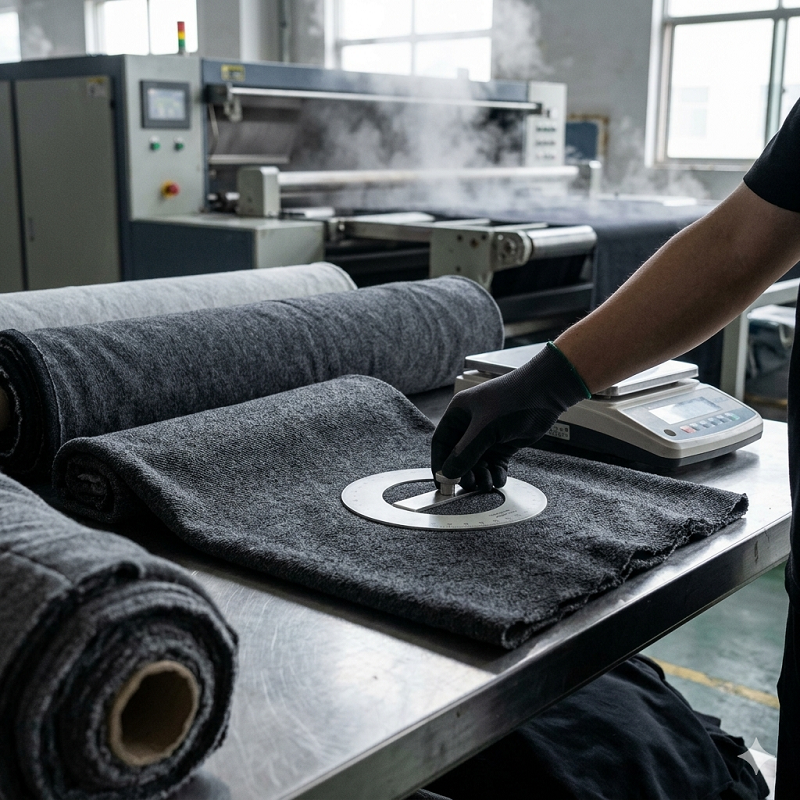
The longevity of any legendary garment begins at the molecular level with yarns and raw fibers. Streetwear diverges fundamentally from mass-market fast fashion through its uncompromising pursuit of heavyweight composition, structural rigidity ("bone feel"), and an ultra-soft organic tactile feel. To ensure that bulk manufacturing matches the approved prototype flawlessly, our Incoming Quality Control (IQC) specialists subject every single batch of raw fabric to an exhaustive physical and chemical evaluation immediately upon arrival.
1.1 Weight Verification & Dimensional Shrinkage Mechanics for 400GSM–600GSM Heavyweight Fabrics
High-end streetwear brands customizing iconic oversized hoodies or heavyweight track pants consistently specify 400GSM, 500GSM, or even ultra-dense 600GSM pure cotton brushed fleece and French Terry fabrics. These materials command immense visual presence, effortlessly maintaining the rigid, architectural silhouettes characteristic of luxury American and European streetwear. However, from a textile physics perspective, higher-weight cotton knits accumulate massive internal tension during weaving. If this internal stress is not completely dissipated before production, it triggers radical shrinkage or severe torque (where side seams twist awkwardly across the body after washing).
Automated Circular Swatch Cutters & Density Micro-Weighing: For every fabric delivery—whether custom-dyed or sourced from premium spot inventories—our IQC technicians extract precise samples from the front, middle, and rear sections of each roll using calibrated circular specimen cutters. These swatches are dried in specialized laboratory ovens at 105°C to achieve standard moisture regain, then weighed on analytical micro-balances. We mandate that the bulk fabric density variance must remain within a strict tolerance of ±2%, ruthlessly rejecting any substandard variations.
Multi-Stage Industrial Pre-Shrinking Protocols: To neutralize the inherent shrinkage volatility of heavy cotton, Chanjoye executes a double-stage physical normalization process prior to cutting. Fabrics first enter computerized stenter-framing systems, utilizing pressurized steam injection to allow cotton fibers to naturally recoil and relax. This is immediately followed by a tensionless compacting pass to seal the dimensional structure. Through this complex industrial matrix, we permanently lock bulk warp (vertical) and weft (horizontal) shrinkage within an elite 2% to 3% limit (far surpassing the loose 5%+ industry average). Overseas consumers can subject these garments to rigorous domestic laundering cycles, and they will maintain their original fit and proportions flawlessly.
1.2 Laboratory-Grade Material Durability & Color Fastness Evaluations
A structurally compliant streetwear piece must survive skateboarding abrasions, high-intensity choreography, and aggressive washing regimes. Our internal testing laboratory is equipped with advanced analytical machinery to verify performance parameters:
Martindale Abrasion & Pilling Resistance Profiling: Utilizing premium Martindale testing machinery, fabric samples are subjected to continuous, multidirectional friction trajectories against standard abrasive textiles under a fixed load for up to 30,000 continuous cycles. Only textiles achieving an international Grade 4 rating or higher (zero surface fuzzing, zero fiber breakage) are granted clearance to enter our cutting patterns.
Rigorous Multi-Dimensional Color Fastness Rubrics: Modern streetwear utilizes deeply saturated palettes—including stark high-street onyx blacks, ultra-vivid Klein blues, and complex garment-dyed earth tones. To ensure these rich pigments do not bleed onto skin, undergarments, or luxury accessories during perspiration or friction, we execute four critical fastness metrics:
1.Color Fastness to Washing: Simulating aggressive multi-cycle laundering at 60°C.
2.Color Fastness to Perspiration: Subjecting samples to simulated acidic and alkaline human sweat profiles under mechanical compression for 4 continuous hours.
3.Color Fastness to Dry Rubbing.
4.Color Fastness to Wet Rubbing.
Our acceptance threshold is strictly fixed at Grade 4-5. This completely eliminates the commercial vulnerability of international customer disputes stemming from dye migration or color loss.
2. Micro-Precision Drafting: Digital Pattern Grading & Tech Pack Engineering
In highly automated apparel manufacturing, the Tech Pack operates as the supreme legal code governing the production floor. If a creative illustration is translated into factory mechanics with a single millimeter of error, thousands of bulk products transform into inventory losses. As an advanced clothing manufacturer guided by an engineering ethos, we never initiate high-speed bulk operations blindly; we shift our quality control focus deeply into the pre-production technical phase.
2.1 3D CAD Pattern Scaling & Geometric Silhouette Optimization
Contemporary high-street streetwear dictates its own meticulous cut geometry. Achieving the perfect dropped shoulder, boxy cropped torso, or engineered sleeve stacking requires specialized proportional scaling rather than basic dimensional enlargement.
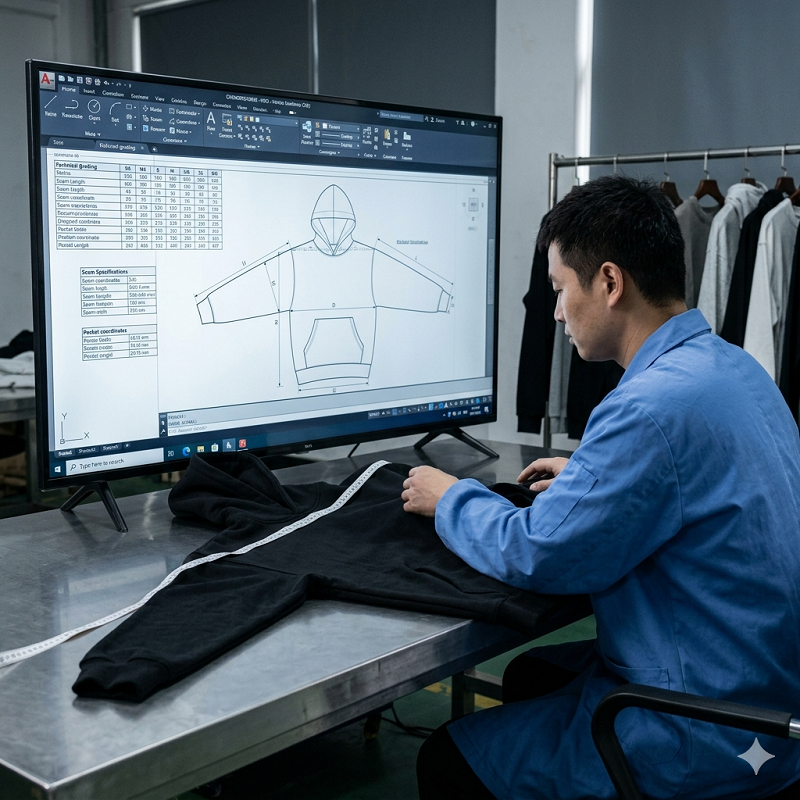
Advanced CAD Digitized Grading Matrixes: Our engineering department utilizes industry-leading apparel CAD ecosystems (such as Gerber and Lectra). Upon receiving a baseline size chart (e.g., Size M) from a client, our master pattern makers do not apply crude percentage-based scaling across the grid. Instead, we recalibrate dimensional allowances around armholes, neck curves, and underarm points relative to the specific physical thickness of the heavyweight fabric. This ensures that from Size S to XXL, the signature structural proportions and aesthetic balance remain perfectly uniform.
Granular Tech Pack Alignment: Prior to the fabric meeting a cutting blade, a cross-functional assembly of pattern makers and QA engineers unpacks every line item of the design. Every variable is permanently digitized: the exact stitch configuration (e.g., 3-needle 5-thread flatlocks, twin-needle lap seams), the exact GSM of internal neck tapes, stitch density limitations (strictly enforced at 10–12 stitches per inch), and absolute spatial coordinates for pocket placements. This data forms our blueprint for production.
2.2 The Pre-Production (PP) Sample "Joint Alignment Review" Protocol
Before bulk raw material processing is activated, the creation of a Pre-Production (PP) Sample serves as an unyielding operational gate. This specific prototype must utilize the actual bulk fabric, the actual custom trims (including branded zippers, dipped drawcords, and custom eyelets), and the exact embellishment methods ordered.
Dynamic Anthropometric Assessment: The completed PP sample is mounted onto calibrated industrial fit-forms and evaluated on real-world fit models to analyze dynamic mobility. The QC team scrutinizes fabric drape, movement behavior, aesthetic balance, and seam stress distribution during active movement, extensions, and stances.
Pre-Production Technical Briefing: Once testing concludes, our QC Director convenes a mandatory technical alignment briefing with our assembly line directors, stitching managers, and print-shop supervisors. The prototype is deconstructed to map out potential hidden variables in mass assembly (e.g., multi-layered pocket intersections proving too thick for standard tracking, which can cause skipped stitches). These focus areas are highlighted in red on our technical manifests, and specific preventative SOPs are deployed. High-speed bulk manufacturing is unlocked only after the client issues formal, written approval.
3. Guardians of the Streetwear Soul: In-Process Quality Control (IPQC) for Graphics & Special Finishes
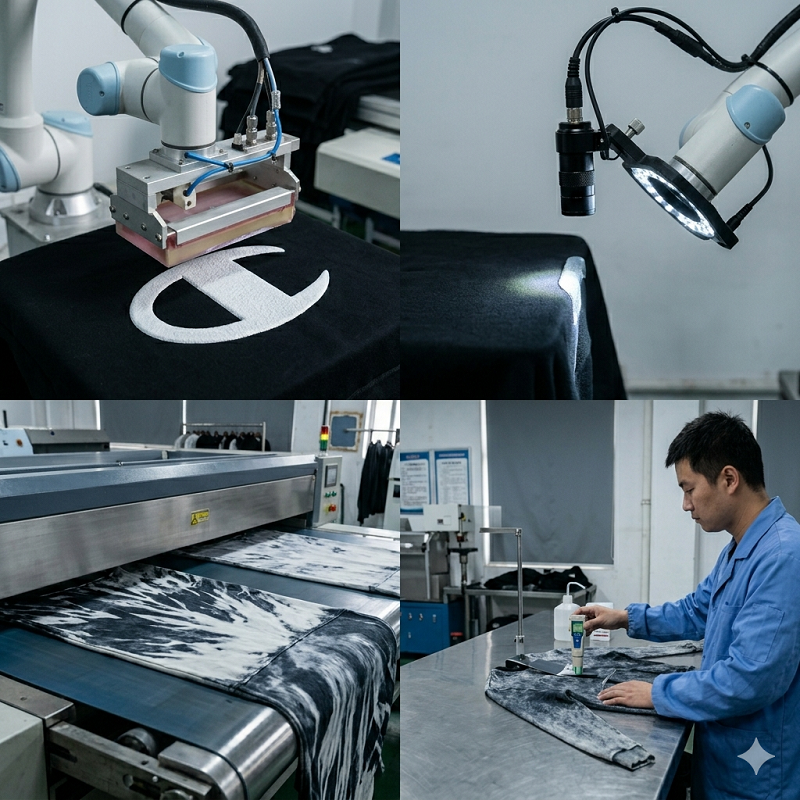
Standard apparel relies on basic tailoring; premium streetwear is defined by its complex surface treatments. Modern streetwear designs leverage heavy embellishments—3D puff screen-printing, high-definition Direct-to-Garment (DTG), plastisol transfers, discharge applications, alongside vintage garment washes like acid washing, raw edge distressing, and sun-fading thermal treatments. Because these methods involve intricate chemical reactions and physical stressors, they represent the highest volatility zone in garment manufacturing. Our In-Process Quality Control (IPQC) infrastructure dedicates intense monitoring resources to these sectors.
3.1 3D Puff Printing: Height Specification, Edge Definition, and Tensile Adhesion
Puff printing remains an iconic aesthetic in Y2K and luxury streetwear due to its high-relief dimension and satisfying, dense tactile feedback. However, this method is highly volatile to thermal variations. Insufficient heat yields flat, uninspired graphics; excessive temperatures fracture the blowing agents, leaving scorched, abrasive textures that peel off completely during initial washes.
Micro-Processor Thermal Profiling: Chanjoye's printing facilities are equipped with automated conveyor curing tunnels governed by multi-zone micro-processor temperature controllers. For premium heavyweight textiles, our engineers lock the expanding thermal profile between 155°C and 162°C, with belt speed calibrated down to the second.
Real-Time Edge Sharpness Auditing: IPQC field inspectors sample cured graphics directly off the conveyor lines every 15 minutes. Utilizing high-magnification optical lenses, they check for paste bleeding or micro-burrs, ensuring every graphical boundary remains razor-sharp.
Violent Multi-Directional Tensile Stress Testing: Once cooled, printed samples undergo manual high-stress elongation checks. The cured graphic must effortlessly expand to the fabric's physical limit without exhibiting micro-fissures or structural separation, returning perfectly to its original geometry upon release. Samples are also routed to our laundry lab for 5 continuous cycles of accelerated mechanical washing to ensure the graphic remains completely permanent.
3.2 Achieving Flawless Consistency in Acid Wash, Cold-Dyeing, and Sun-Fading Aesthetics
Weathered, distressed visual textures are highly valued in modern streetwear collections. Yet, industrial acid washing and pigment depletion are hypersensitive to water hardness, volcanic pumice stone friction intervals, chemical saturation ratios, and extractor rotation velocities. A minor calculation error can turn a bulk delivery into irregular, mismatching garments plagued by severe color shading.
Spectrophotometric Matching Inside Multi-Source Lightboxes: Before reaching the pressing tables, every single washed hoodie must pass through our standardized spectrophotometric color-matching bays. Under D65 (Artificial Daylight), TL84 (European Store Illuminant), and CWF light arrays, color specialists with over a decade of evaluation experience compare each item against the client's approved control standard. We mandate that lot-to-lot color alignment registers at an elite Grade 4-5 on the International Geometric Grey Scale, entirely filtering out visible shading variances.
Absolute pH Neutralization & Toxic Odor Extraction: Severe acid wash or enzymatic degradation methods leave heavy concentrations of oxidizers and caustic chemical residues within dense cotton structures. If neutralization is bypassed, these compounds degrade cotton fibers over time (causing premature holes) and imbue garments with harsh, volatile chemical odors. Chanjoye prioritizes premium consumer safety and skin health; our wash protocols require three separate stages of reverse-overflow rinsing combined with eco-friendly neutralizing compounds. Before unloading, every batch is checked to ensure the textile pH matches human skin health parameters (maintaining a safe pH balance between 5.5 and 7.0). We guarantee that when overseas consumers unbox your product, they encounter the clean scent of premium cotton rather than chemical odors.
4. Precision at the Assembly Line: Cutting & Stitching Controls (SOP)
While premium fabric forms the foundation of a garment, industrial stitching provides its underlying structural integrity. Within our production facility, meticulous Standard Operating Procedures (SOPs) turn our master tailors into active quality guardians.
4.1 Automated Fabric Spreading, Micro-Precision Cutting, and Intricate Pattern Alignment
Cutting dictates the geometric accuracy of a garment. Heavy cotton fabrics possess notable mass; when stacked high for traditional manual cutting, the downward pressure of the blade and material weight cause substantial displacement between the top and bottom layers. This yields asymmetrical panels and unequal sleeve lengths.
Micro-Processor Computerized Vacuum-Assisted Cutters: Chanjoye operates high-precision automated CNC cutting lines. Prior to blade deployment, the system triggers a powerful vacuum down-draft, compressing multi-layered fabric stacks into a rigid, unified block. High-frequency oscillating knives, guided by micro-processors tracking the digital CAD coordinates, execute cuts with an exact tolerance of within 0.5mm. This guarantees surgical symmetry across all assembled components.
High-End Engineered Pattern Matching: For textiles featuring heritage flannels, street plaids, structural stripes, or complex All-Over Prints (AOP), we execute a meticulous, high-consumption pattern-matching technique. At all seam junctions, we ensure that horizontal lines align perfectly across the front and rear panels, creating a seamless visual flow at the side seams—a premium detail that highlights our capabilities as an advanced clothing manufacturer.
4.2 The Physics of Sewing: High-Tensile Seams, Coverstitching, and Stress-Point Bartacking
Streetwear garments are engineered for active lifestyles, including skateboarding and high-motion urban activities. This demands exceptional seam elasticity and structural tear resistance.
Premium Core-Spun Threading & Calibrated Stitch Density: We reject low-grade polyester threads, utilizing high-tensile, core-spun threads from leading brands (such as Coats). For fabrics exceeding 400GSM, stitch density is strictly locked at 10 to 12 stitches per inch. This prevents seam grin or gap exposure under tension while avoiding fiber perforation that could weaken heavy cotton material.
3-Needle 5-Thread Coverstitching & Interlocking Seams: Critical structural junctions—including necklines, shoulder drops, armholes, and waistbands—are finished using industrial 3-needle 5-thread coverstitching or twin-needle automatic flat felling. This structural weave forms an elastic protective webbing on the reverse side of the seam, allowing international consumers to pull heavy garments on and off without experiencing broken threads.
Computerized Bartack Reinforcements at High-Stress Vectors: The openings of kangaroo pockets on hoodies, cargo side pockets, and drawstring exits are prone to structural tearing under tension. Our assembly lines deploy dedicated computerized bartacking stations at these anchor points, weaving dense, multi-directional reinforcing clusters to secure the fabric. This process infuses Chanjoye-manufactured apparel with rugged, military-grade durability.
5. The Zero-Defect Terminal: Final Quality Control (FQC) & 100% Garment Auditing
After traveling through cutting, assembly, embellishment, and pressing, a garment's manufacturing journey is still not complete. It must pass our ultimate gatekeeper before international shipment: Final Quality Control (FQC). At this terminal stage, our auditing teams check each item through the critical lens of a discerning consumer.
5.1 Comprehensive 100% Manual Visual & Dimensional Audits
While volume-focused factories rely on relaxed AQL 2.5 statistical sampling matrices to minimize labor overhead and accelerate hand-offs, Chanjoye maintains a strict 100% piece-by-piece full inspection policy for bulk production. Our professional examiners evaluate every single article on high-luminance, shadowless inspection tables across an uncompromising rubric:
Static Dimensional Conformity Verification: Inspectors lay each garment flat on calibrated measuring platforms, utilizing precision steel rules to check 12 critical structural metrics—including chest width, total length, sleeve reach, and collar span—against the approved technical data sheet. We enforce a narrow tolerance of within ±1cm. Any item slipping outside this parameter is flagged and routed back to the assembly line for complete reconstruction.
Exhaustive Surface Anomaly Cleansing: Our teams screen every surface for skipped stitches, thread breaks, oil stains, fabric scorching, print porosity, or surface glazing caused by excessive ironing temperatures. This ensures every garment looks pristine upon delivery.
Pneumatic Three-Dimensional Thread Extraction: Streetwear manufacturing processes leave loose threads behind. We utilize specialized trimming workstations equipped with high-pressure pneumatic vacuums and micro-shears. We mandate that no loose threads exceeding 2mm may remain on the exterior, interior, or within the pocket structures of the garment, providing an exceptional unboxing experience for your retail audience.
5.2 Uncompromising Product Safety: High-Sensitivity Conveyorized Metal Detection
As a globally compliant manufacturer familiar with strict consumer safety standards (such as US CPSIA and European REACH regulations), we enforce a zero-tolerance policy regarding foreign object contamination.
Automated Ferromagnetic Broken Needle Detection: During high-speed sewing operations, micro-fragments of steel machine needles can occasionally fracture and become embedded deep within heavy fleeces or multi-layered pockets. These fragments cannot be caught by visual inspection alone. If shipped overseas, they pose a severe physical risk to consumers, exposing brand owners to devastating legal liabilities and punitive fines.
Chanjoye provides a reliable safety guarantee: Every completed garment must pass through our automated high-sensitivity conveyorized metal detection systems immediately prior to polybagging. This equipment detects ferromagnetic particles down to 1.0mm in diameter. If a fragment is encountered, an alarm sounds, the conveyor belt reverses automatically, and the item is isolated for extraction. Delivering 100% needle-free merchandise is our core commitment to your brand's security.
Conclusion: Partner with Chanjoye for a Quantifiable, Worry-Free Supply Chain
In the traditional apparel manufacturing industry, offering a verbal promise like "we prioritize quality" takes only a second. However, embedding that standard into thousands of stitches across a high-volume manufacturing run requires a disciplined, data-driven, and highly structured industrial quality control architecture.
At Chanjoye (https://www.chanjoye.com/), we operate as a dedicated, specialized streetwear manufacturer. We recognize that every garment we craft carries your brand's identity and represents your reputation in front of your consumers.
We rely on hard data, standardize production via clear technical tech packs, and assume complete accountability for your investment through 100% piece-by-piece final inspections. If you are looking for a reliable, factory-direct custom clothing manufacturer capable of executing your forward-thinking designs without quality compromises, contact our B2B expert team today. Let our precision craftsmanship build the dependable foundation your fashion brand deserves.
📞 Phone: [86-15015158179]
📧 Email: [info@chanjoye.com]
🌐 WhatsApp:[https://wa.me/8618025298509]
Click the link above to start designing your custom streetwear today. We can’t wait to help you express your bold style!