Why Low MOQ Clothing Manufacturers are the Ultimate Game-Changers for Emerging Streetwear Brands
Introduction: The Rise of Streetwear and the Crucial Role of the Supply Chain
In today’s hyper-accelerated, rapidly evolving global fashion ecosystem, streetwear has completely shed its niche, subcultural origins to become the dominant, mainstream force dictating global fashion trends. From the gritty skate parks of New York and the trend-setting boutique alleys of Ura-Harajuku in Tokyo, all the way to the pristine runways of high-fashion weeks in Paris and Milan, emerging streetwear brands are springing up globally at an unprecedented rate. According to recent global fashion market reports, the streetwear sector has ballooned into a multi-billion-dollar industry. However, lurking behind this glamorous facade is a brutal commercial reality: over 80% of emerging streetwear brands suffer severe financial crises or outright bankruptcies within their first two crucial years of operation. The primary culprit for this high mortality rate is rarely a lack of design talent or an uninspiring brand philosophy. Rather, startup brands are routinely crushed by the insurmountable barriers of traditional supply chains—specifically, the draconian requirement of "High Minimum Order Quantities (MOQ)" and the devastating mountains of dead inventory that inevitably follow.
In direct response to this critical industry pain point, the era of Flexible Supply Chains and Low MOQ Clothing Manufacturers has arrived. As a deeply experienced, professional custom clothing manufacturer with a fully optimized production infrastructure, we understand on a granular level how every single link in the supply chain can create a butterfly effect that dictates a startup brand's survival. In this comprehensive, deep-dive industry guide, we will analyze, from the authoritative perspective of a veteran apparel manufacturer, exactly why finding a high-quality manufacturing partner that supports low MOQs is the foundational key for emerging streetwear brands to shatter industry barriers, maintain positive cash flow, and achieve scalable, profitable growth.
1. The "Slow Suffocation" of Startups by Traditional High MOQs

Before fully appreciating the disruptive, transformative power of the low MOQ model, we must first dissect the fundamental mechanics of traditional clothing manufacturing and why it is so hostile to startup brands. Conventional apparel OEM (Original Equipment Manufacturer) factories built decades ago were designed exclusively to service the massive, highly standardized industrial runs of fast-fashion giants. To amortize machine setup fees, mold costs, and assembly line overhead, these traditional factories rigidly enforce minimum orders of 500, 1,000, or even several thousand pieces per style and colorway. For an emerging brand operating on seed money or bootstrapped funds, meeting these demands is akin to commercial suicide. The fatal impacts are evident in three core areas:
Instant Evaporation of Startup Cash Flow: Early-stage brands operate with extremely shallow budget pools. If forced to comply with a 1,000-piece MOQ, founders are compelled to sink 70%—or even all—of their initial capital into invisible production phases. This immediate "financial hemorrhage" leaves the brand with zero ammunition for the vital operations that actually drive sales. Suddenly, the brand cannot afford to hire senior graphic artists for visual branding; they cannot fund location shoots at brutalist raw concrete industrial sites to capture that premium, edgy streetwear Lookbook aesthetic; and they have zero budget left for crucial digital marketing strategies like Google SEO (EEAT/AEO optimization), robust website development, or targeted influencer (KOL) campaigns on Instagram and TikTok. In modern e-commerce, without marketing capital, your brand is functionally invisible.
The Abyss of Inventory Risk and Brand Devaluation: Streetwear is a hyper-volatile category driven fiercely by social media algorithms and rapidly shifting cultural zeitgeists. Consumer tastes can pivot drastically within a single quarter. If a founder, fueled by overconfidence, blindly commits to manufacturing 500 units of a highly specific Y2K-style cropped graphic hoodie, and the market reaction is lukewarm, those hundreds of unsold garments instantly morph from projected assets into crippling liabilities. Deadstock not only incurs expensive warehousing fees and blocks capital circulation but also forces the brand into desperate, heavy-discount clearance sales. Slashing prices destroys the "premium, exclusive, and limited" aura the streetwear label desperately tried to cultivate, ultimately alienating early adopters.
Severe Restriction of Product Lines and Creative Diversity: Exorbitant MOQ thresholds force brands into a state of extreme creative conservatism when launching new "Drops." Terrified of producing garments that won't sell enough to cover the massive initial outlay, founders back away from avant-garde destructive tailoring, costly experimental fabrics, or complex, heavy-duty printing techniques. Instead, they reluctantly produce the "safest," most generic basic hoodies with simple logo slaps. This compromise strips the brand of the very essence of streetwear—raw individuality, rebellious edge, and unique identity—reducing them to just another forgettable, fast-moving consumer good.
2. The Strategic Acceleration Effect of Low MOQ Clothing Manufacturers
A capable, professional clothing manufacturer willing to support small batch runs of 100 or even 50 pieces per style is not merely a "factory taking orders"—they are the most robust strategic partner and accelerator behind an emerging brand. The low MOQ model fundamentally rewrites the rules of commercial testing and brand operation.
2.1 Drastically Optimizing Cash Circulation and Reallocating Budgets to Marketing
A low MOQ ecosystem means brands can translate conceptual, paper-based designs into physical, high-quality garments with astonishingly low trial-and-error costs. If the initial production expenditure for a new Capsule Collection drops by 60%-70% due to smaller runs, that massive chunk of liberated, liquid capital can be aggressively injected directly into customer acquisition funnels. Brands can invest in high-quality, SEO-driven blog content to capture organic traffic; they can produce visually arresting, cinematic commercial campaigns; or they can sponsor underground hip-hop artists and local skate competitions to build grassroots authenticity. In today's landscape where digital traffic is increasingly expensive, the universal secret of successful B2B and B2C global brands is keeping healthy cash flow circulating at the frontend marketing level while minimizing backend production risks.
2.2 Enabling True Agile Development and Rapid A/B Testing Models
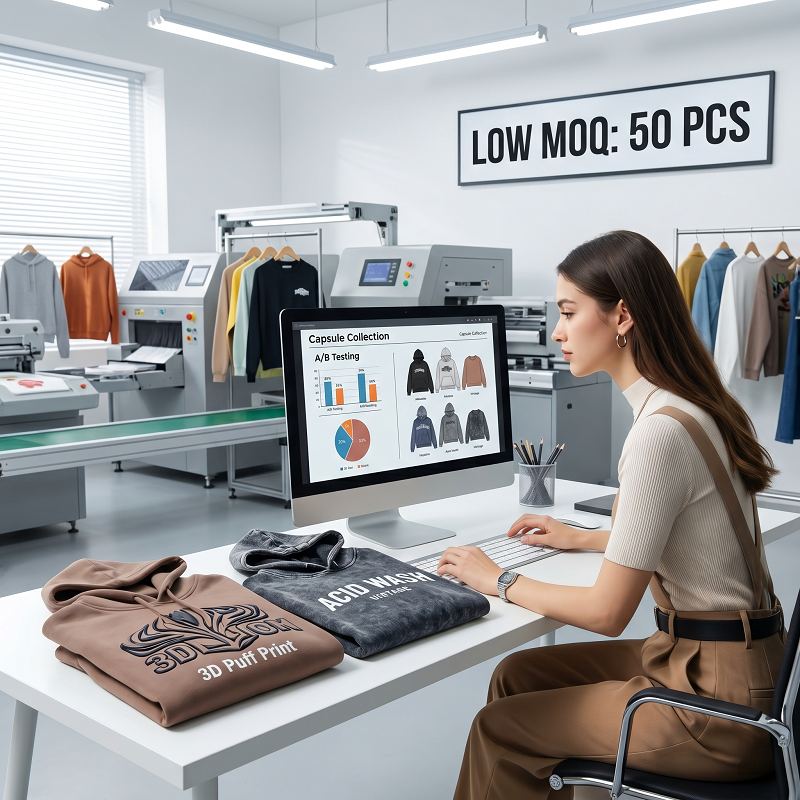
The velocity of fashion trend evolution is faster than ever before. The minimalist "Old Money" aesthetic dominating social feeds yesterday might be violently overthrown by the oversized, rebellious proportions of 90s Vintage Hip-Hop styles tomorrow. As a top-tier clothing manufacturer intimately familiar with industry rhythms, we utilize flexible production lines to empower brands with agile, software-like development cycles. A brand can simultaneously drop 5 radically different designs (testing various silhouettes, prints, and wash treatments), cautiously producing only 50-100 units of each to conduct real-world A/B testing. By analyzing hard data—add-to-cart rates and actual conversions—brands can instantly kill the underperforming styles while issuing rapid restock commands to our factory for the viral hits. This "fail-fast, data-driven, zero-inventory" production model is only executable when backed by a highly responsive low MOQ manufacturer.
2.3 Uncompromising Texture: Executing Premium Crafts and Heavyweight Fabrics in Small Batches
This is the ultimate litmus test separating a low-end "sweatshop" from a premium "supply chain powerhouse." Many bottom-tier factories advertise low MOQs as bait, but they trap clients into using cheap synthetic blends that pill instantly and standard rubber prints that crack after three washes. The true competitive moat of an elite streetwear manufacturer lies in providing industry-leading, heavy-duty supply chain resources regardless of the order size:
Mastering Heavyweight, Premium Fabrics: Today’s Premium Streetwear consumer is obsessed with the physical hand-feel, structure, and drape of a garment. An exceptional manufacturer provides stable sourcing and custom development for 400g, 500g, and even luxurious 600g high-GSM pure cotton French terry, fleece, or double-yarn jersey. These heavyweight fabrics allow brands to engineer oversized hoodies and tees with architectural structure, stiffness, and a luxurious streetwear vibe, immediately distinguishing them from flimsy fast-fashion alternatives.
Complex Specialty Printing and High-End Dyeing: The soul of a streetwear piece is often concentrated in its graphic execution. Professional manufacturers excel far beyond basic screen printing and DTG. Even for small orders, we flawlessly execute highly technical processes like 3D Puff Printing (ensuring sharp edges, even expansion, and zero deflation), high-density silicone printing, chenille embroidery, and flocking. In terms of post-processing, we can precisely replicate garments steeped in vintage history using techniques like intense Acid Washing, natural Sun-fading effects, Snow washing, and bespoke Garment Dyeing. These highly complex procedures, requiring immense chemical expertise and eco-friendly processing, are usually rejected by large factories as "nuisance orders." However, as a flexible manufacturer dedicated to streetwear, we democratize these top-tier techniques for every ambitious startup.
3. Redefining the Excellent Manufacturer: Comprehensive End-to-End Empowerment
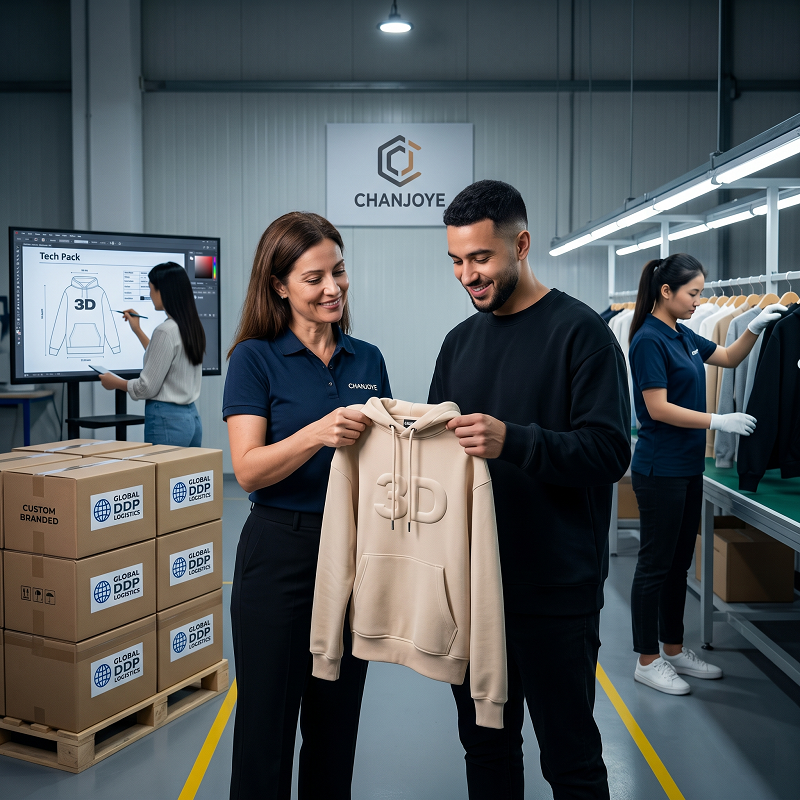
For visionary brand founders targeting the global market, sourcing a supply chain must go far beyond superficially hunting for the "lowest MOQ" and "cheapest unit price." A genuinely Excellent Clothing Manufacturer must operate as a fully integrated entity possessing end-to-end OEM/ODM capabilities, offering a closed-loop solution from raw inspiration to final global delivery.
3.1 1-on-1 Technical Translation: From Abstract Concept to Perfect Garment
Many gifted emerging brand founders possess incredible graffiti art skills, deep roots in skate culture, or a brilliant intuitive sense of color palettes, yet they completely lack the technical apparel engineering skills required to create standard "Tech Packs" that factories understand. Professional manufacturers house dedicated teams of veteran fashion designers and senior pattern makers to provide "nanny-level" technical support. We handle everything from interpreting initial moodboards and refining 1-on-1 design sketches, to global sourcing of specific trims, precise pattern drafting, and 3D virtual sampling. Our expert pattern makers deeply understand the evolving fit preferences of Western markets, ensuring that whether a brand demands body-con Y2K aesthetics or the exaggerated, boxy fits paying homage to the golden era of 90s hip-hop, the sample perfectly captures the brand's DNA on the first try.
3.2 Unforgiving 8-Step Quality Control (QC) Systems
"Small batch" must never equate to "low quality" or "amateur operation." Conversely, high-ticket streetwear demands QC standards exponentially stricter than standard apparel. Operating with decades of deep OEM heritage, we refuse to compromise on quality, strictly enforcing ISO9001 and international quality management standards across all lines through an 8-Core Quality Inspection Protocol:
Fabric Intake Testing: Rigorously testing every fabric roll for accurate GSM, shrinkage rates (ensuring shape retention post-wash), and colorfastness (preventing dye bleeding).
Cutting and Stitching Audits: Ensuring stitch density meets premium standards, with critical stress points (necklines, drop shoulders) reinforced with double-needle or overlock stitching.
Specialty Print/Wash Stress Tests: Conducting specific tensile stretching and rigorous machine-wash tests on 3D puff prints to guarantee zero peeling or cracking, alongside ensuring batch-to-batch consistency in vintage washes.
Final Comprehensive Inspection: Every single garment must pass at least 15 manual checkpoints before leaving the facility, including trimming loose threads and precision pressing. We don't just promise high yield rates; we actively welcome and support clients or authoritative third-party agencies (like SGS) to conduct independent inspections, ensuring with absolute transparency that every delivered piece effortlessly commands a high retail premium.
3.3 Supply Chain Integration and Seamless Global Logistics
Once a flawless product rolls off the line, delivering it safely, efficiently, and elegantly to the client or end consumer is the final and most crucial touchpoint of the brand experience. An internationally minded manufacturer provides frictionless, global door-to-door (DDP/DDU) logistics solutions. Through deep, official strategic partnerships with global freight giants like DHL, FedEx, UPS, and specialized cross-border sea/air forwarders, we secure highly competitive rates for our clients (saving up to 15%-20% on shipping costs) while guaranteeing highly predictable transit times (5-8 days via expedited air, 25-35 days via fast sea freight). Furthermore, recognizing the supreme importance of the "unboxing experience" in streetwear, we offer one-stop customization for premium woven neck labels, heavyweight specialty paper hangtags, security tags, and custom frosted EVA eco-packaging. Even a modest 100-piece order will arrive looking and feeling indistinguishable from the world's most elite luxury streetwear houses.
4. Conclusion: A Superior Manufacturer is the Ultimate Architect of Your Brand’s Empire
In conclusion, Low MOQ Clothing Manufacturers have historically emerged as the ultimate game-changers for streetwear startups because they use sheer manufacturing flexibility to obliterate the arrogant, towering barriers of traditional supply chains. They have truly democratized the "supply chain privileges" once reserved solely for multinational conglomerates. They endow startup founders with the courage to test the treacherous waters of the fashion market, safeguard the brand's most vital lifeline—cash flow—and flawlessly translate a designer's wildest, most avant-garde concepts into highly covetable, physical reality through the luxurious application of heavyweight fabrics and highly technical vintage wash processes.
In today’s fiercely competitive and saturated global fashion arena, flashy marketing is undeniably important, but the hard power of your supply chain is the widest, most impenetrable moat your brand can build. As a professional custom streetwear manufacturer relentlessly dedicated to "creating infinite possibilities through extreme craftsmanship and agile response," we firmly believe that impeccable product quality, highly accessible minimum order policies, and deeply professional end-to-end closed-loop services are the most powerful weapons we provide. We are here to help every ambitious, visionary streetwear brand rise from underground garages to the global fashion stage. Do not allow the archaic rules of high MOQs to suffocate your raw creativity. By aligning with a manufacturing partner who genuinely understands streetwear culture, complex craftsmanship, and modern commerce, your brand is fully equipped to become the next unstoppable global phenomenon.
📞 Phone: [86-15015158179]
📧 Email: [info@chanjoye.com]
🌐 WhatsApp:[https://wa.me/8618025298509]
Click the link above to start designing your custom streetwear today. We can’t wait to help you express your bold style!